Cultivation, Collection, Processing & Conservation of Medicinal Plants
Relying exclusively on wild forest harvesting has pushed critical medicinal species to the brink of extinction. Commercial cultivation guarantees pure, disease-free, high-yield medicinal crops that meet stringent international regulatory quality. In this unit, we explore plant cultivation methods, WHO GACP guidelines, plant growth hormones, polyploidy, in-situ/ex-situ conservation, and the eco-pharmacognostic rescue of endangered Himalayan herbs like Kutki and Chirata.
In this topic, you will learn:
1. Methods of Plant Cultivation and WHO GACP Guidelines
Modern Plant Cultivation & Tissue Culture (Defined Simply):
Simple Definition:
Good Agricultural and Collection Practices (WHO-GACP) are defined as international standardized quality guidelines designed to guarantee that medicinal plant raw materials are produced safely, sustainably, free from toxic agrochemicals, and with consistent phytochemical potency.
Plants grown from fertilized true seeds (e.g., Cinchona, Nux vomica, Ispaghula, Senna).
- Advantage: Produces genetically diverse, vigorous plants with deep root systems.
- Limitation: High genetic variation; slow germination; seed dormancy requires scarification.
Plants multiplied using vegetative parts: Cuttings, Rhizomes (Ginger, Turmeric), Tubers (Potato), Bulbs (Garlic), Runners (Peppermint).
- Advantage: Produces genetically identical clones retaining 100% of the high-yielding parent chemical traits.
- Limitation: Can transmit viral systemic infections to the entire crop.
Visual Diagram: The 5 Standard Steps of WHO-GACP Compliance
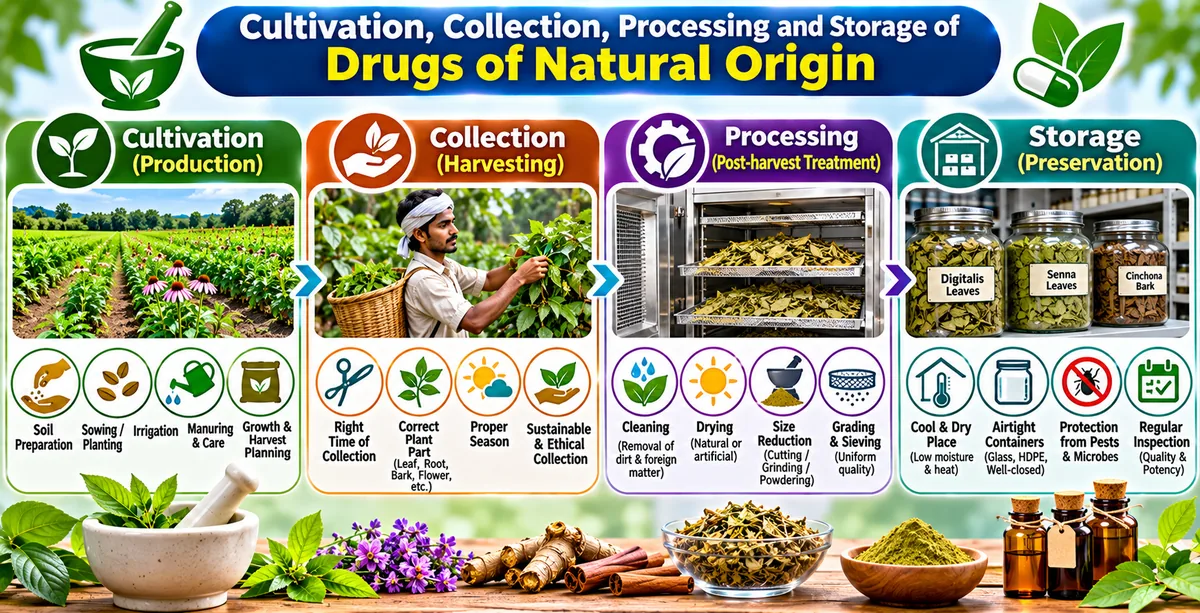
2. Factors Influencing Cultivation, Collection, Processing and Storage
Certain active compounds synthesize only at high altitudes (e.g., Cinchona requires 1,000–2,500 m elevation; Tea requires high altitude mist; Pyrethrum needs cold nights for pyrethrin flowers).
Peppermint requires long sunny days for high Menthol synthesis; absence of full sunlight causes menthol to convert into unwanted menthofuran.
Sandy loam soil is required for subterranean roots and rhizomes (Ginger, Turmeric, Rauwolfia) so they can expand easily without rotting.
• Leaves: Collected just before flowering (photosynthesis at peak).
• Barks: Collected in spring during sap rise (easy peeling).
• Roots: Autumn when foliage withers.
Excess moisture triggers enzymatic hydrolysis and mold growth (Aflatoxins). Volatile oil drugs must be dried in shade at ≤ 40°C to prevent aroma evaporation.
Light-sensitive drugs (Digitalis, Belladonna) must be stored in well-closed amber glass or moisture-proof containers with silica desiccant bags.
3. Plant Growth Regulators (Hormones) in Cultivation of Medicinal Plants
Plant Hormones (Phytohormones) are defined as organic chemical messengers synthesized in tiny concentrations that regulate physiological growth, flowering, and secondary metabolite biosynthesis:
| Hormone Class | Primary Natural Examples | Specific Pharmacognostic & Agricultural Application |
|---|---|---|
| 1. Auxins | IAA, IBA, NAA, 2,4-D | Stimulates rapid adventitious root initiation in vegetative stem cuttings; prevents premature fruit drop. |
| 2. Gibberellins | Gibberellic Acid (GA₃) | Breaks stubborn seed dormancy; causes internodal stem elongation and dramatic increases in leaf biomass in medicinal crops. |
| 3. Cytokinins | Kinetin, Zeatin, BAP | Promotes active cell division and shoot formation in plant tissue culture; delays leaf yellowing (senescence). |
| 4. Abscisic Acid (ABA) | ABA (Stress Hormone) | Triggers stomatal closure during severe drought stress, protecting valuable crops from water loss. |
| 5. Ethylene | Ethephon (Gaseous hormone) | Induces uniform commercial fruit ripening and promotes natural latex flow in rubber and opium incisions. |
4. Polyploidy, Mutation and Hybridization in Enhancing Secondary Metabolites
Polyploidy is defined as the condition of possessing three or more complete sets of chromosomes (3n, 4n).
Pharmacognostic Value: Treating seedlings with the alkaloid Colchicine (0.1%) arrests spindle fibers during mitosis, producing tetraploids (4n) with gigantic leaves and doubling alkaloid content (e.g., Tetraploid Datura stramonium produces 200% higher Scopolamine).
Sudden, heritable changes in genetic DNA sequence induced artificially using physical mutagens (Gamma rays, UV) or chemical mutagens (EMS).
Application: Produces novel strains of Mentha arvensis resistant to fungal rust and mutant strains of Papaver somniferum devoid of narcotic morphine but rich in therapeutic Thebaine.
Controlled cross-pollination between genetically dissimilar species or varieties to combine desirable traits into a single superior offspring.
Application: Cinchona ledgeriana hybridized with Cinchona succirubra yields hybrid trees with high Quinine bark concentration plus high disease resistance.
5. In-Situ vs. Ex-Situ Conservation and Value Addition
• In-Situ Conservation is defined as conserving medicinal plants within their natural native ecosystems and wild habitats. It is also known as: On-site conservation. It is used for: Protecting entire wild biodiversity corridors and enabling natural evolutionary adaptation. For example: National parks, wildlife sanctuaries, and biosphere reserves.
• Ex-Situ Conservation is defined as preserving medicinal plants outside their natural habitats in protected artificial environments. It is also known as: Off-site conservation. It is used for: Safeguarding critically endangered species from immediate extinction. For example: Botanical gardens, cryogenic seed gene banks, and tissue culture repositories.
A. In-Situ Conservation ("On-Site")
Conserving wild medicinal plants in their natural native forest ecosystems:
- Biosphere Reserves & National Parks: Complete legal protection from logging and poaching.
- Sacred Groves: Ancient community-protected virgin forest patches preserved through religious reverence in India.
- Advantage: Allows natural evolutionary adaptation and symbiotic microbial root interactions to continue uninterrupted.
B. Ex-Situ Conservation ("Off-Site")
Conserving endangered germplasm outside their native natural habitat in controlled facilities:
- Botanical Gardens & Herbal Arboreta: Cultivating living collections.
- Seed Banks: Dehydrated seeds stored in deep freezing (-20°C).
- Cryopreservation: Preserving shoot tips and meristems in liquid nitrogen at -196°C for centuries without metabolic aging.
6. Role of Eco-Pharmacognosy and Sustainable Conservation (Kutki & Chirata)
Simple Definition:
Eco-Pharmacognosy is defined as the modern interdisciplinary science combining classical pharmacognosy, plant ecology, and sustainable agro-technology to conserve endangered medicinal plants from wild over-exploitation while preserving biodiversity.
A critically endangered Himalayan alpine herb (3,000–5,000 m). Its rhizomes contain powerful hepatoprotective iridoid glycosides: Picroside-I and Kutkoside.
A bitter Himalayan medicinal plant containing Swertiamarin, Amarogentin, and Mangiferin, widely used in antimalarial, antidiabetic, and digestive formulations.