Introduction to Psychology in Healthcare
Healthcare is not just about prescribing chemicals and medicines; it is about treating living human beings who have emotions, thoughts, fears, and personal habits. Healthcare psychology helps pharmacists understand how patients think, why they forget their medicines, how they perceive physical pain, and how we can motivate them to adopt healthy behaviors.
In this topic, you will learn:
1. Definition, Scope, and Relevance of Psychology in Health Sciences

Simple Definition:
Psychology is defined as the scientific study of human mind and behavior—how people perceive their surroundings, think, feel, learn, and act under normal health and during illness.
In modern healthcare, treatment follows the Biopsychosocial Model. This model states that health and illness are determined by three interconnected factors:
Viruses, bacteria, organ pathology, genetics, biochemical imbalances, and anatomy.
Stress, fear of needles, depressive thoughts, memory lapse, health beliefs, and mood.
Family support, cultural traditions, socioeconomic status, and workplace environment.
Relevance of Psychology for Pharmacists:
- Improving Medication Adherence: Over 50% of patients with chronic diseases (like high BP and diabetes) stop taking their medicines on time. Psychology explains why patients quit and how to fix this habit.
- Relieving Patient Anxiety: Patients admitted to hospitals or awaiting surgery experience acute fear; psychological empathy keeps them calm and cooperative.
- Understanding Pain & Suffering: Pain is not only a physical sensation; psychological stress magnifies pain intensity.
- Managing Placebo & Nocebo Responses: A positive belief in a medicine enhances its biological healing (placebo effect), while fear of side effects triggers real physical nausea (nocebo effect).
2. Branches of Psychology with Healthcare Relevance
Four primary branches of psychology directly influence clinical healthcare and pharmacy practice:
A. Clinical Psychology
Clinical psychology is defined as the branch of psychology concerned with the assessment, diagnosis, treatment, and prevention of mental disorders and severe emotional distress.
- • It is also known as: Mental healthcare psychology.
- • It is used for: Diagnosing depression, bipolar disorder, schizophrenia, and assisting clinical pharmacists in psychotropic drug monitoring.
• Scope: Evaluates conditions like major depression, bipolar disorder, schizophrenia, and severe anxiety.
• Healthcare Application: Helps clinical pharmacists understand psychotropic drug therapy (antidepressants, antipsychotics) and behavioral side effects.
B. Health Psychology
Health psychology is defined as the study of how psychological, cultural, and behavioral factors contribute to physical health, illness prevention, and wellness.
• Scope: Explores how lifestyle choices (smoking, unhealthy diet, physical inactivity) lead to cardiovascular diseases.
• Healthcare Application: Enables community pharmacists to run smoking cessation programs, diabetic diet counseling, and wellness coaching.
C. Behavioural Psychology
Behavioural psychology is defined as the scientific analysis of observable behaviors and the environmental stimuli that condition, reinforce, and shape human actions.
• Scope: Employs concepts of classical conditioning, operant conditioning, and behavioral modification.
• Healthcare Application: Designing reminder apps, reward calendars, and dosage pillboxes that reinforce daily pill-taking habits.
D. Developmental Psychology
Developmental psychology is defined as the study of physical, emotional, and cognitive changes that occur across human life from infancy to old age.
• Scope: Explains developmental milestones (Piaget's cognitive stages, Erikson's psychosocial stages).
• Healthcare Application: Communicating differently with a 6-year-old child vs. an 80-year-old geriatric patient suffering from mild dementia.
3. Sensation, Perception, and Attention in Clinical Assessment
Sensation vs. Perception (Explained Simply):
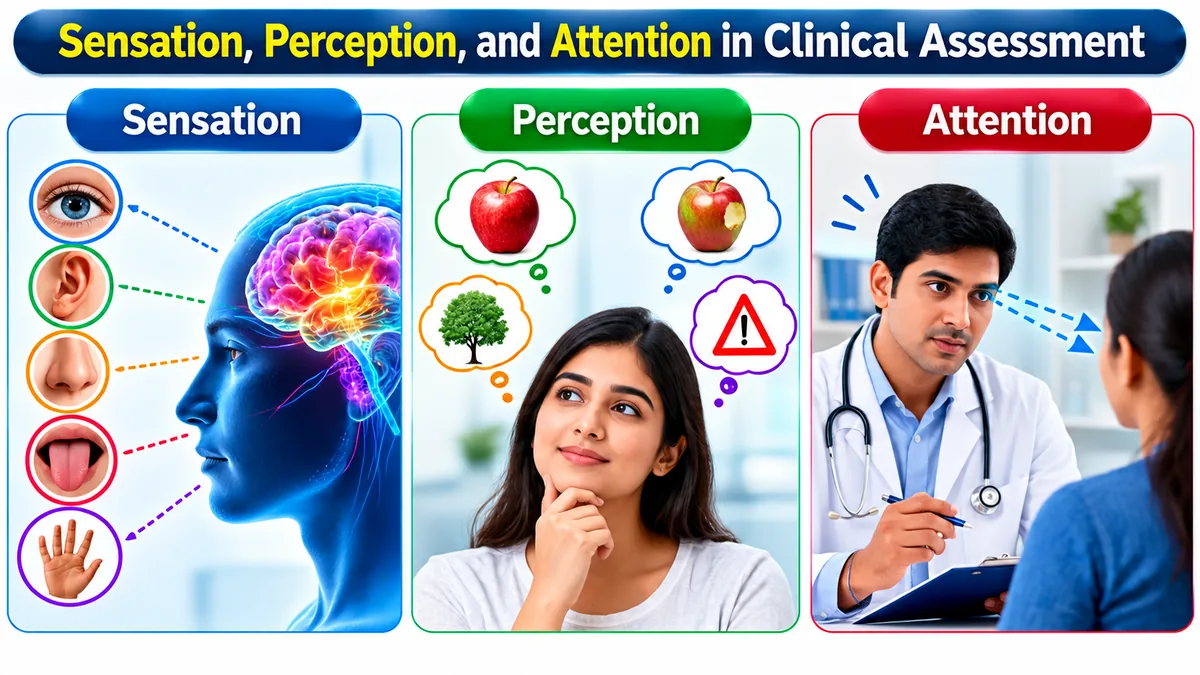
What is Sensation?
Sensation is defined as the passive physiological detection of environmental stimuli by our sensory organs (eyes, ears, skin nerve endings) and transmission of nerve impulses to the spinal cord and brain.
Example: Pain receptors in a diabetic foot detecting tissue pressure.
What is Perception?
Perception is defined as the active psychological process by which the brain organizes, interprets, and gives meaning to sensory input based on past experiences and expectations.
Example: A patient interpreting a chest tightness as a deadly heart attack, triggering panic.
Visual Diagram: The Clinical Perception Pathway in Patient Assessment
Role of Attention in Clinical Assessment:
Attention is defined as the cognitive ability to concentrate selectively on one specific aspect of information while ignoring distracting environmental inputs.
- Selective Attention: A patient experiencing severe pain has narrowed attention; they cannot absorb complex multi-step medication schedules. Pharmacists must give simple, written instructions.
- Divided Attention: Elderly patients trying to handle multiple prescription bottles simultaneously make frequent dosage errors.
4. Learning and Memory: Reinforcement in Health Behaviour Change
Simple Definition:
Learning is defined as a relatively permanent change in human behavior or knowledge brought about by experience, practice, or conditioning.
Learning through association: an involuntary reflexive response becomes linked to a new neutral trigger.
Learning through consequences: behaviors followed by positive rewards are repeated, while behaviors followed by negative outcomes decrease.
Reinforcement Principles in Health Behaviour Change
| Type of Reinforcement | Mechanism (What Happens) | Healthcare Application Example |
|---|---|---|
| Positive Reinforcement | Adding a pleasant reward to encourage repeating the behavior. | A pharmacist warmly praises a diabetic patient whose HbA1c dropped, motivating them to continue strict diet. |
| Negative Reinforcement | Removing an unpleasant stimulus after performing a healthy action. | Taking an antacid removes painful stomach burning; this removal reinforces taking the medicine. |
| Punishment | Presenting an unpleasant outcome to stop an unhealthy behavior. | Severe nausea and vomiting caused by Disulfiram if an alcoholic drinks liquor. |
| Extinction | Withholding rewards until an unwanted behavior gradually fades away. | Refusing to yield to a tantrum when a toddler refuses oral syrup, so the habit ends. |
Memory & Patient Counseling:
Memory operates in three stages: Sensory Memory (< 1 sec), Short-Term Working Memory (holds 5 to 7 items for ~20 seconds), and Long-Term Memory.
The Primacy and Recency Effect: Patients remember best what the pharmacist tells them first (Primacy) and last (Recency), while forgetting the middle details. Pharmacists should state the most critical drug precautions first and review them last!
5. Emotion and Motivation: Theories and Implications in Health Contexts
What is Emotion?
Emotion is defined as a complex psychological state that involves three components: a subjective experience (feeling fear), physiological arousal (heart pounding, sweating), and a behavioral/expressive reaction (trembling, crying).
What is Motivation?
Motivation is defined as the internal physiological or psychological drive that initiates, directs, and sustains goal-oriented actions (e.g., sticking to a low-salt diet to avoid heart attack).
Visual Diagram: Maslow's Hierarchy of Human Needs Applied to Healthcare
Clinical Takeaway: A patient experiencing extreme acute pain (Level 1) or financial terror regarding drug costs (Level 2) cannot focus on long-term lifestyle wellness goals (Level 5). We must stabilize basic safety needs first!
Classic Theories of Emotion in Clinical Practice:
Physiological response comes first, followed by emotion: "My heart is racing, therefore I must be frightened."
Physiological arousal and emotional feeling happen simultaneously through thalamic activation.
Emotion depends on physiological arousal PLUS cognitive interpretation: "My heart is racing, the doctor has a serious face, so this report must be dangerous."
Instead of ordering or lecturing an overweight hypertensive patient, the pharmacist asks empathetic open questions: "What are some reasons you would like to lower your blood pressure?" This taps into intrinsic motivation (internal desire to see their children grow up) which produces lasting behavior change far better than external fear.