Fundamentals of Pharmacognosy and Classification of Crude Drugs
Nature is the world's greatest organic chemical laboratory. Over 40% of all modern prescription medicines—from life-saving painkillers to anticancer drugs—originated directly from plants, animals, marine organisms, and microorganisms. In this introductory unit, we explain the definition, history, and scope of pharmacognosy, sources of drugs, major historical drug discoveries, official herbal pharmacopoeias, and the 6 classic schemes of crude drug classification.
In this topic, you will learn:
1. Definition, History, Present Status and Scope of Pharmacognosy
Simple Definition:
Pharmacognosy is defined as the comprehensive scientific study of raw, unrefined medicinal substances of biological origin (crude drugs obtained from plants, animals, microbes, and minerals) covering their botanical source, cultivation, collection, extraction, chemical constituents, and therapeutic applications.
Etymology and Historical Evolution:
The word "Pharmacognosy" is derived from two Greek words: Pharmakon (meaning a drug or medicine) and Gnosis (meaning knowledge or study).
- C.A. Seydler (1815): A medical student in Halle, Germany, first introduced the term Pharmacognosie in his doctoral dissertation titled "Analecta Pharmacognostica".
- Pedanius Dioscorides (1st Century AD): Greek physician who wrote the historic five-volume encyclopedia "De Materia Medica", describing over 600 medicinal plants.
- Ancient Indian Medicine: Detailed in the Charaka Samhita (internal medicine herbs) and Sushruta Samhita (surgical plant remedies and wound healing).
Modern Scope and Future Prospects:
Natural chemical structures act as lead prototypes (e.g., synthetic Procaine was synthesized by chemically modifying natural Cocaine).
Booming multi-billion dollar global industry in standardized plant extracts (Ginkgo biloba, Ginseng, Curcumin) and dietary supplements.
Producing expensive anticancer secondary metabolites (like Taxol and Vincristine) in industrial bioreactors without cutting wild forests.
2. Sources of Drugs of Natural Origin
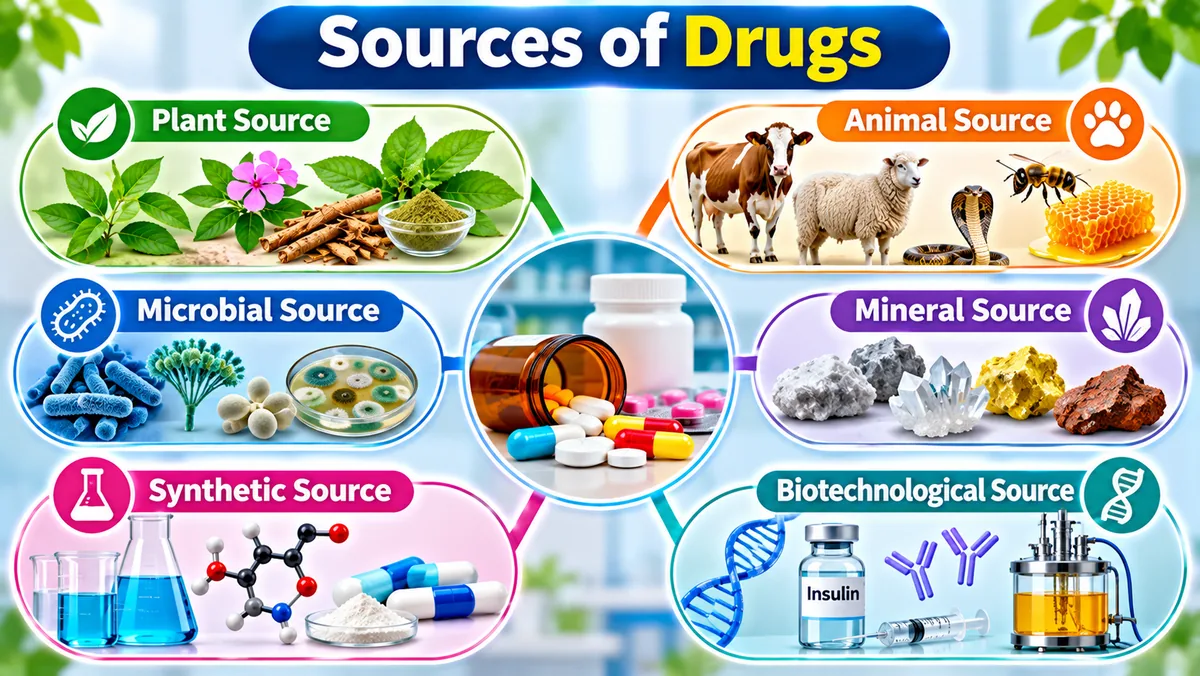
A Crude Drug is defined as any naturally occurring, unrefined plant, animal, or mineral substance in its original raw state, having undergone only collection and drying:
Largest natural pharmacy: Leaves (Digitalis, Senna), Barks (Cinchona, Cinnamon), Roots (Rauwolfia, Ginger), Seeds (Nux vomica, Ispaghula).
Insulin (bovine/porcine pancreas), Heparin (porcine intestinal mucosa), Cod Liver Oil (vitamins A & D), Beeswax, Gelatin, Wool fat (Lanolin).
Antibiotics: Penicillin (Penicillium chrysogenum), Streptomycin (Streptomyces griseus), Cyclosporin A (immunosuppressant fungus).
Sponges, corals, and sea squirts producing powerful bioactive molecules: Cytarabine (Ara-C anticancer from sea sponge), Trabectedin.
Inorganic pharmaceutical excipients and minerals: Kaolin, Talc, Bentonite, Calamine, Chalk, and Fuller's earth.
In vitro mass cell suspension cultures of Taxus and Catharanthus roseus yielding uniform, pathogen-free bioactive metabolites.
3. Historical Milestones in Natural Drug Discovery
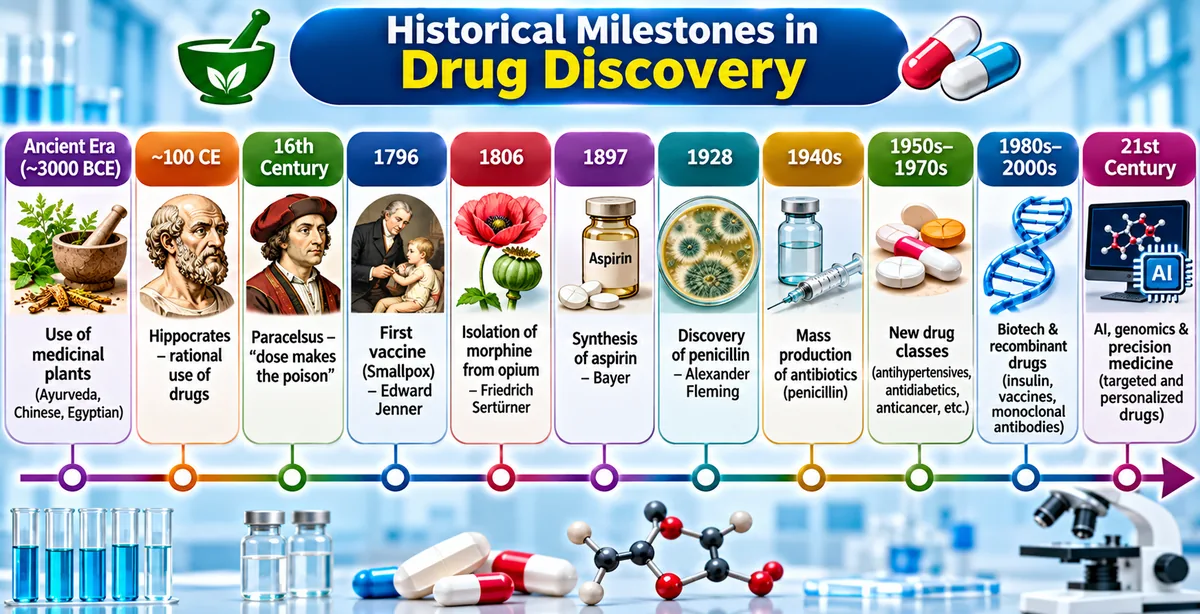
The isolation of pure crystalline active compounds from crude herbs transformed pharmacy from empirical folklore into modern molecular medicine:
| Drug Molecule | Natural Source | Discoverer & Year | Therapeutic Significance |
|---|---|---|---|
| Morphine | Opium poppy (Papaver somniferum) | Friedrich Sertürner (1805) | First pure alkaloid ever isolated; potent narcotic analgesic gold standard. |
| Quinine | Cinchona bark (Cinchona calisaya) | Pelletier & Caventou (1820) | Saved millions of lives as the first effective antimalarial treatment. |
| Aspirin (Salicin) | White willow bark (Salix alba) | Felix Hoffmann / Bayer (1897) | Acetylsalicylic acid; world's most consumed analgesic and cardioprotective antiplatelet. |
| Warfarin | Spoiled sweet clover (Dicoumarol) | Karl Paul Link (1940) | Oral anticoagulant preventing strokes and pulmonary embolism. |
| Penicillin | Mold (Penicillium notatum) | Alexander Fleming (1928) | Inaugurated the modern antibiotic era against bacterial infections. |
| Cephalosporin | Sewage fungus (Cephalosporium acremonium) | Giuseppe Brotzu (1948) | β-lactam bactericidal antibiotics resistant to staphylococcal penicillinase. |
| Taxol (Paclitaxel) | Pacific yew bark (Taxus brevifolia) | Wani & Wall (1971) | Microtubule stabilizer; revolutionary anticancer drug for ovarian and breast cancer. |
| Artemisinin | Sweet wormwood (Artemisia annua) | Tu Youyou (1972 - Nobel Prize 2015) | Sesquiterpene lactone cure for multidrug-resistant falciparum malaria. |
4. Introduction to Different Herbal and Traditional Pharmacopoeias
- • It is also known as: The official statutory drug compendium of India.
- • It is used for: Enforcing mandatory legal quality, identity, and purity standards for all allopathic medicines and standardized herbal extracts.
- • For example: Official monographs on Senna leaf, Digitalis, and Curcumin extracts.
- • It is also known as: The official standard compendium for Ayurvedic medicines.
- • It is used for: Providing legal pharmacopoeial standards for authentic single plant parts and classical polyherbal formulations across India.
- • For example: Standards for Ashwagandha root, Tulsi leaves, and Triphala formulations.
Official standards published by Ministry of AYUSH for single Unani crude drugs (Mufradat) and classical compound formulations (Murakkabat).
Published by the British Herbal Medicine Association (BHMA); gives botanical descriptions, assay standards, and therapeutic monographs for Western herbal drugs.
United States Pharmacopeial Convention's compendium covering internationally traded botanical ingredients, dietary supplements, and TLC fingerprinting.
Authoritative critical monographs providing rigorous botanical validation, TLC identification, chemical assays, and clinical safety data.
5. Official vs. Non-Official and Codified vs. Non-Codified Drugs
Official vs. Non-Official Drugs
• Official Drug: A drug listed in the current edition of an authorized national pharmacopoeia (e.g., Senna Leaf IP, Ginger IP). It is legally bound to meet official pharmacopoeial purity standards.
• Non-Official Drug: A substance previously recognized in older editions but omitted from the current pharmacopoeia, or an unregistered commercial herb that has not yet gained statutory entry.
Codified vs. Non-Codified Drugs
• Codified Traditional Drugs: Natural remedies whose formulas, preparation methods, and therapeutic uses are formally documented in classical ancient texts recognized by drug regulatory acts (e.g., Ayurveda, Siddha, Unani, Sowa-Rigpa).
• Non-Codified Folk Medicines: Tribal, ethnomedicinal, and household folklore herbal remedies handed down orally through generations without formal textual codification.
6. The 6 Schemes of Crude Drug Classification (Merits & Limitations)
Crude Drug Classification Schemes (Explained Simply):
Fundamental Distinction: Organized vs. Unorganized Drugs
Direct morphological anatomical plant or animal organs containing cellular structure. E.g., Leaves (Digitalis), Barks (Cinchona), Woods (Quassia), Flowers (Clove), Roots (Rauwolfia).
Non-cellular exudates, secretions, or physical extracts obtained by incision, boiling, or expression. E.g., Dried latices (Opium), Gums (Acacia), Resins (Asafoetida), Dried juices (Aloe).
| Classification Scheme | Criteria / Basis | Merits (Advantages) | Limitations (Drawbacks) |
|---|---|---|---|
| 1. Alphabetical | Latin or English alphabetical names (A to Z) as in pharmacopoeias (IP, BP, USP). | Simple, easy to locate drugs quickly like a dictionary. | No scientific relationship, chemical nature, or therapeutic correlation. |
| 2. Morphological | Based on anatomical plant part: Leaves, Barks, Flowers, Roots, Gums, Resins. | Ideal for identifying raw drugs and detecting adulteration in commercial trade. | Does not reflect chemical constituents or medicinal actions. |
| 3. Taxonomical (Botanical) | Botanical evolutionary hierarchy: Class → Order → Family → Genus → Species. | Precise botanical identification and evolutionary relationships. | Failed to correlate with therapeutic use or chemical structures. |
| 4. Chemical | Based on primary chemical nature of active principles: Alkaloids, Glycosides, Tannins, Lipids. | Preferred by phytochemists; directly links to isolation methods. | Ambiguity when a single plant contains multiple major chemical classes. |
| 5. Pharmacological | Based on therapeutic pharmacological actions (Cardiotonics, Purgatives, Carminatives). | Most useful for clinical practice, prescribing, and pharmacology studies. | Drugs with completely different chemistry are grouped together. |
| 6. Chemotaxonomical | Correlates chemical constituents with botanical phylogenetic family classification. | Deep scientific modern insight into plant biosynthesis and new drug discovery. | Requires sophisticated analytical instrumentation (HPLC, MS). |