Plant Metabolites and Traditional Systems of Medicine
Plants synthesize two broad categories of organic chemicals: primary metabolites needed for basic survival, and secondary metabolites developed for chemical defense, ecological adaptation, and healing. In this comprehensive unit, we explore the chemistry, extraction, and diagnostic chemical tests of alkaloids, glycosides, tannins, flavonoids, volatile oils, and resins, followed by the foundational philosophies of AYUSH (Ayurveda, Unani, Siddha, Homeopathy) and Traditional Chinese Medicine (TCM).
In this topic, you will learn:
1. Primary vs. Secondary Plant Metabolites
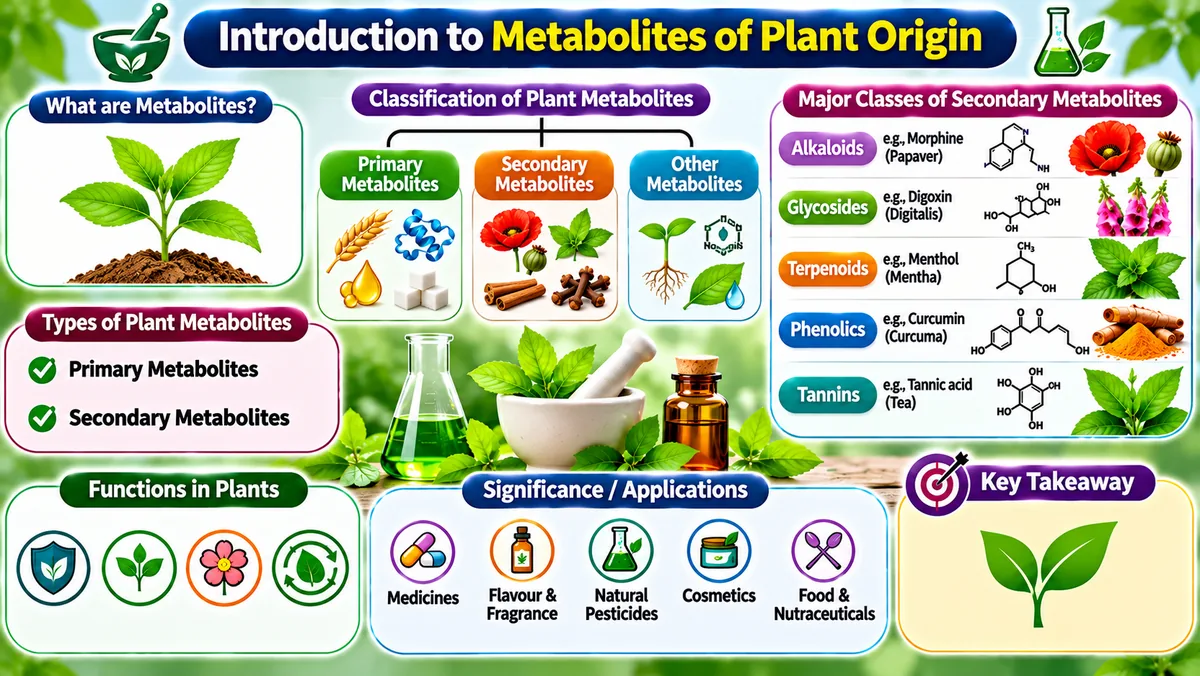
Plant Metabolites (In Simple Words):
Plant Metabolites are defined as organic chemical molecules produced by plant cells through enzyme-catalyzed biochemical pathways.
- • Primary Metabolites are defined as universal biological molecules directly essential for plant growth, respiration, and cellular reproduction. It is also known as: Fundamental plant nutrients. It is used for: Basic cellular survival and food storage. For example: Carbohydrates (starch, cellulose), Proteins (enzymes), and Lipids (fixed oils).
- • Secondary Metabolites are defined as specialized chemical compounds biosynthesized from primary pathways that provide survival, defense, and ecological advantages against predators and pathogens. It is also known as: Natural active pharmaceutical ingredients. It is used for: Formulating life-saving medicines and herbal drugs. For example: Morphine (alkaloid from Opium for pain), Digoxin (glycoside from Foxglove for heart failure), and Curcumin (polyphenol from Turmeric).
| Feature | Primary Metabolites | Secondary Metabolites |
|---|---|---|
| Physiological Role | Directly involved in basic physiological survival, cell division, photosynthesis, and respiration. | Non-essential for immediate survival; functions in defense against insects, UV protection, and pollinator attraction. |
| Occurrence Across Kingdom | Universally present in all living green plant species. | Taxonomically restricted to specific plant families, genera, or species. |
| Chemical Examples | Carbohydrates (Starch, Glucose), Proteins, Lipids, Nucleic Acids. | Alkaloids (Morphine), Glycosides (Digoxin), Tannins, Flavonoids, Volatile oils. |
| Pharmacological Value | Nutritional value and pharmaceutical excipients (binders, diluents). | High therapeutic potency; active pharmaceutical ingredients (APIs). |
2. Major Secondary Metabolites & Diagnostic Qualitative Chemical Tests
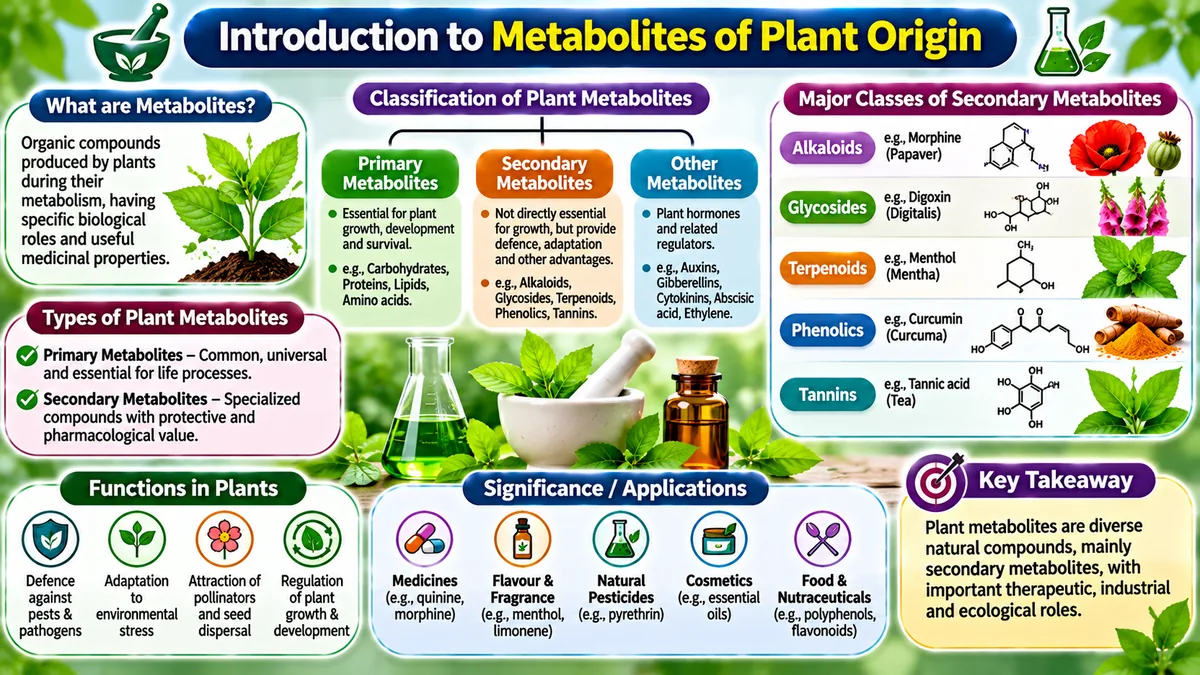
In pharmacognosy and natural product quality control, powdered plant extracts are systematically identified using characteristic colorimetric and precipitation reagents:
| Metabolite Class | Chemical Definition & Examples | Specific Test Name & Reagent | Positive Observation |
|---|---|---|---|
| Alkaloids | Basic nitrogenous heterocyclic compounds with intense physiological action (Atropine, Quinine, Morphine). | 1. Mayer's Reagent (Potassium mercuric iodide) | Cream / Pale yellow precipitate |
| 2. Dragendorff's Reagent (Potassium bismuth iodide) | Orange-red precipitate | ||
| 3. Wagner's Reagent (Iodine in Potassium iodide) | Reddish-brown precipitate | ||
| 4. Hager's Reagent (Saturated Picric acid solution) | Bright yellow precipitate | ||
| Glycosides | Molecules yielding one or more sugars (glycone) and a non-sugar (aglycone) upon enzymatic hydrolysis. | 1. Borntrager's Test (Anthraquinones: Senna, Cascara) | Rose-pink / Red color in ammoniacal layer |
| 2. Keller-Kiliani Test (Cardiac: Digoxin / Digitoxose) | Reddish-brown junction ring; upper acetic layer turns blue-green | ||
| 3. Foam Test (Saponins: Senega, Dioscorea) | Persistent thick honeycomb foam (> 2 cm) lasting > 10 min | ||
| Tannins | High molecular weight polyphenols that precipitate proteins and tan animal hides into leather. | 1. Ferric Chloride (FeCl₃) Test | Blue-black (Hydrolyzable tannins) or Brownish-green (Condensed tannins) |
| 2. Goldbeater's Skin Test | Ox intestine membrane stains permanent dark black after washing | ||
| Flavonoids | 15-carbon polyphenolic pigments with potent free-radical antioxidant scavenging power (Rutin, Quercetin). | Shinoda Test (Magnesium turnings + Conc. HCl) | Brilliant pink, scarlet, or magenta red color |
3. Traditional Systems of Medicine: AYUSH and TCM
The Ministry of AYUSH in India integrates six officially recognized indigenous healthcare systems: Ayurveda, Yoga & Naturopathy, Unani, Siddha, Sowa-Rigpa, and Homeopathy, alongside Traditional Chinese Medicine (TCM):
Originated in India > 5,000 years ago. Health is defined as equilibrium of the 3 biological humors (Tridoshas) and harmony of body, mind, and spirit.
Founded by Hippocrates and Galen, refined by Avicenna (Ibn Sina). Based on 4 Body Humors (Dam-blood, Balgham-phlegm, Safra-yellow bile, Sauda-black bile).
Founded by Dr. Samuel Hahnemann (1796). Guided by the Law of Similars ("Like cures like") and serial potentization of minimum doses.
Based on the complementary balance of Yin and Yang, smooth flow of vital energy (Qi) along bodily meridians, and the Five Elements.
4. Fundamental Principles of Ayurveda: Tridosha and Panchamahabhutas
Traditional Ayurvedic Concepts (Explained Simply):
Ayurveda is defined as the 5000-year-old traditional Indian healthcare system based on maintaining harmony between body, mind, and nature. It is also known as: The "Science of Life" (Ayu = life, Veda = knowledge). It is used for: Holistic disease prevention, health preservation, and natural plant therapeutics.
The Panchamahabhutas (5 Basic Elements of the Universe):
Ayurvedic philosophy asserts that everything in the cosmos and human body is composed of five universal elements:
Space / Ether
Air / Movement
Fire / Metabolism
Water / Cohesion
Earth / Structure
The Tridosha Theory (3 Fundamental Biological Humors):
Principle of biological kinetic movement, nerve impulses, and breathing.
Principle of transformation, digestion, metabolic heat, enzymes, and vision.
Principle of physical structure, lubrication, tissue strength, and immunity.
5. Types of Dosage Forms in AYUSH Medicines
| AYUSH Dosage Form | Pharmaceutical Method of Preparation | Official Pharmacopoeial Examples |
|---|---|---|
| Asava & Arishta | Sweet, pleasant self-fermented hydroalcoholic liquid preparations (containing 5%–12% self-generated alcohol) prepared by fermenting fresh herb juices (Asava) or boiled decoctions (Arishta) with Dhataki flowers and jaggery. Indefinite shelf life! | Draksharishta (cough & digestion), Ashokarishta (gynaecological). |
| Bhasma | Ultra-fine, nano-sized calcinated metallic or mineral powders prepared by repetitive incinerations (Puta) with herbal juices until the metal loses its toxicity and gains high bio-absorption. | Swarna Bhasma (Gold nano-ash), Lauha Bhasma (Iron for anaemia). |
| Churna | Fine dry powder of cleaned, dried, pulverized medicinal herbs passed through sieve #80. | Triphala Churna (Haritaki, Bibhitaki, Amla), Sitopaladi Churna. |
| Gutika / Vati | Solid compressed pills or molded tablets made from powdered drugs rolled with syrup or guggulu gum. | Chandraprabha Vati, Yograj Guggulu. |
| Taila & Ghrita | Medicated oils (Taila) and clarified cow's butter (Ghrita) boiled with herbal paste and decoctions until all water evaporates and fat-soluble phytochemicals are extracted. | Brahmi Ghrita (memory & brain), Mahanarayan Taila (joint pain). |
| Kwatha (Kashayam) | Aqueous decoction prepared by boiling 1 part coarse crude drug with 16 parts water until reduced to 1/4th volume. | Dashamoola Kwatha, Mahasudarshan Kwatha (antipyretic). |
6. Role of Pharmacognosy in Modern Allopathy and Traditional Herbal Systems
Pharmacognosy validates ancient claims with modern chemical evidence—for example, validating turmeric's traditional anti-inflammatory reputation by identifying molecular NF-κB inhibition by Curcumin.
Enables fingerprinting of complex Ayurvedic syrups using modern HPTLC, ensuring reproducible batch-to-batch clinical efficacy.