History of Pharmacy, Pharmacopoeias & Prescriptions
Welcome to Topic 1 of General Pharmacy (BP102T). This lecture guide covers the entire official syllabus heading-by-heading: the history of pharmacy in India (education, industry, organizations), the scope of the pharmacy profession, official pharmacopoeias (IP, BP, USP, BPC, Int. Ph, NFI), study of a model IP monograph, parts of a prescription, how to handle prescriptions, and common Latin medical terms.
1. History of Pharmacy in India in Relation to Pharmacy Education
Simple Definition:
Pharmacy is defined as the health science that links medical science with chemistry. It is responsible for the discovery, production, control, disposal, and safe and effective use of medications.
- • It is also known as: The profession of compounding and dispensing medicines.
- • Pharmacy Education in India: Introduced in 1932 by Prof. M. L. Schroff (revered as the Father of Pharmacy Education in India) at Banaras Hindu University (BHU).
- • Pharmacy Council of India (PCI): Constituted under the Pharmacy Act 1948 to regulate pharmacy qualifications and education standards across India.
In ancient times, medicine knowledge was passed down through the Guru-Shishya parampara using classical Ayurvedic texts like Charaka Samhita and Sushruta Samhita. There were no separate pharmacy colleges.
During the early British period, compounders and dispensers received only basic apprentice training in hospitals without any scientific syllabus. The systematic growth of pharmacy education happened through the following major milestones:
Milestone 1: The Chopra Committee (1930)
The British Government appointed the Drugs Enquiry Committee under the chairmanship of Col. R. N. Chopra. The committee pointed out that India had no trained pharmacists and strongly recommended starting university-level pharmacy degree courses.
Milestone 2: Prof. M. L. Schroff & Banaras Hindu University (1932)
Prof. Mahadeva Lal Schroff is revered as the "Father of Pharmacy Education in India". In 1932, he introduced pharmacy as a subject at Banaras Hindu University (BHU), and in 1937, he launched the very first 3-year Bachelor of Pharmacy (B.Pharm) degree course in India. Later, he also initiated M.Pharm education in 1940.
Milestone 3: The Pharmacy Act (1948) & Education Regulations
The Government enacted the Pharmacy Act in 1948 to regulate education. Under this act, the Pharmacy Council of India (PCI) was constituted in 1949. The PCI framed the Education Regulations (ER), which prescribed the minimum standards for the Diploma in Pharmacy (D.Pharm) and Degree (B.Pharm) across the country.
Milestone 4: Introduction of Doctor of Pharmacy (Pharm.D) & Modern Courses
In 2008, PCI introduced the 6-year clinical Pharm.D (Doctor of Pharmacy) program to prepare pharmacists for direct hospital patient care. Under the National Education Policy (NEP 2020) and the PCI 2026 Curriculum, pharmacy education now integrates computer programming (Python), data analytics, and modern clinical skills.
2. History of Pharmacy in India in Relation to Pharmaceutical Industries
Before the 20th century, almost 100% of allopathic medicines sold in India were imported from England, Germany, and France. India had no domestic drug industry. The growth of the Indian pharmaceutical industry can be understood in four phases:
Birth of Indigenous Manufacturing
• 1901: Acharya Prafulla Chandra Ray established Bengal Chemical and Pharmaceutical Works in Calcutta, the very first modern pharmaceutical factory in India.
• 1907: Prof. T.K. Gajjar and B.D. Amin founded Alembic Chemical Works at Baroda to manufacture spirituous medicines.
• Small units like Bengal Immunity (1919) were established to make vaccines and sera.
Public Sector Leadership
The Government of India set up public sector units to produce affordable life-saving medicines:
• Hindustan Antibiotics Limited (HAL) in 1954 at Pimpri (Pune) to make Penicillin.
• Indian Drugs and Pharmaceuticals Limited (IDPL) in 1961 to manufacture synthetic bulk drugs and antibiotics.
The Generic Revolution
The Patents Act 1970 allowed process patents instead of product patents for medicines. This allowed Indian scientists to develop new, cost-effective chemical routes (reverse engineering), giving rise to private pharma giants like Ranbaxy, Cipla, Dr. Reddy's, Lupin, and Sun Pharma.
"Pharmacy of the World"
Today, India ranks 3rd globally by production volume and 14th by value. India supplies over 20% of global generic drugs, over 60% of world vaccines (Serum Institute of India, Bharat Biotech), and has the largest number of US FDA-approved pharmaceutical plants outside the United States.
3. History of Pharmacy in India in Relation to Pharmaceutical Organizations
Professional organizations protect the rights of pharmacists, maintain ethics, set education standards, and represent India on international platforms. Here are the premier pharmaceutical organizations in India:
| Organization | Full Form | Year Founded | Key Role & Contribution |
|---|---|---|---|
| IPA | Indian Pharmaceutical Association | 1939 | Founded by Prof. M.L. Schroff. It is the premier association of pharmacists in India, represents India at the International Pharmaceutical Federation (FIP), and publishes the Indian Journal of Pharmacy. |
| PCI | Pharmacy Council of India | 1949 | Statutory apex body under the Ministry of Health. Regulates pharmacy education, inspects and approves colleges, and maintains the Central Register of Pharmacists. |
| CDSCO | Central Drugs Standard Control Organization | 1971 | Headed by the Drugs Controller General of India (DCGI). Regulates drug approvals, clinical trials, import licenses, and sets standards under the Drugs and Cosmetics Act. |
| IHPA | Indian Hospital Pharmacists Association | 1963 | Promotes hospital pharmacy practice, patient safety, hospital drug store management, and publishes the Indian Journal of Hospital Pharmacy. |
| APTI | Association of Pharmaceutical Teachers of India | 1966 | Dedicated to pharmacy teachers, advancing teaching pedagogy, research grants, and curriculum development. |
| IPGA | Indian Pharmacy Graduates' Association | 1973 | Unites degree-holding pharmacy graduates, works for career advancement, and advises government on pharmacy policy. |
| IPC | Indian Pharmacopoeia Commission | 2005 (Autonomous) | Headquartered at Ghaziabad. Publishes the Indian Pharmacopoeia (IP), National Formulary of India (NFI), and manages the Pharmacovigilance Programme of India (PvPI). |
4. Scope of the Pharmacy Profession: Roles and Responsibilities
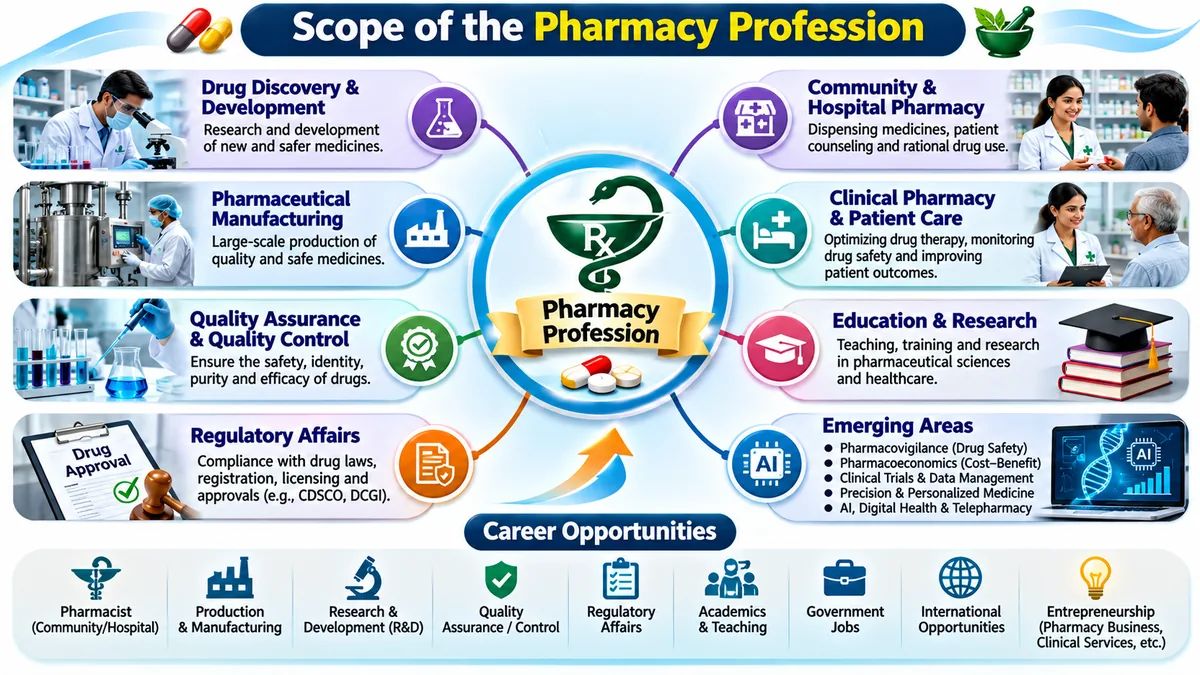
A. Community / Retail Pharmacy
• Dispensing: Accurately checking and dispensing prescription medicines.
• Patient Counseling: Explaining dose, frequency (before/after food), and side effects.
• Storage & Inventory: Maintaining cold chain (2°C to 8°C) for vaccines and insulin.
• Health Screening: Monitoring blood pressure, blood glucose, and advising on OTC medicines.
B. Hospital & Clinical Pharmacy
• Inpatient Dispensing: Supplying medicines to ICU and ward patients.
• Compounding: Preparing sterile IV admixtures and total parenteral nutrition (TPN).
• Clinical Rounds: Working alongside doctors, checking drug-drug interactions.
• TDM: Therapeutic Drug Monitoring for narrow index drugs (Digoxin, Phenytoin).
C. Industrial Pharmacy & R&D
• Formulation & R&D: Designing new tablets, syrups, and drug delivery systems.
• Production: Manufacturing batches following Current Good Manufacturing Practices (cGMP).
• QC & QA: Testing raw materials, packaging, and finished products in labs.
• Regulatory Affairs: Filing drug dossiers (CTD format) with CDSCO and US FDA.
5. Pharmacopoeias & Official Books
Simple Definition:
A Pharmacopoeia is defined as an official book published by the authority of a government containing a list of medicines, their descriptions, purity tests, formulas, and legal standards.
- • It is also known as: The official drug book of India (IP).
- • It is used for: Setting legal standards of identity, purity, and strength for all medicines manufactured and sold in India.
- • Published by: The Indian Pharmacopoeia Commission (IPC), Ghaziabad under the Drugs and Cosmetics Act 1940.
- • It is also known as: The UK national pharmacopoeia (BP).
- • It is used for: Providing statutory standards for pharmaceutical ingredients and medicines in the United Kingdom and Commonwealth nations.
- • It is also known as: The American official drug compendium.
- • It is used for: Specifying legal standards in the USA; USP sets standards for active drug substances (APIs), while the National Formulary (NF) sets standards for pharmaceutical excipients.
- • It is also known as: The dispenser's reference manual.
- • It is used for: Formulating, preparing, and compounding extemporaneous medicines in pharmacies and hospital dispensaries.
- • It is also known as: The WHO global pharmacopoeia.
- • It is used for: Creating uniform global quality specifications for priority essential medicines and orphan drugs worldwide.
Published by IPC Ghaziabad; guides doctors and pharmacists on rational medicine use, dosage, and side effect management.
6. Structure and Content of the Indian Pharmacopoeia (IP)
Modern editions of the Indian Pharmacopoeia (such as IP 2018 / IP 2022) are published in 4 volumes:
- Volume I: Notice, Preface, Introduction, General Notices, and General Chapters (apparatus, dissolution testing, chromatography HPLC/GC, and microbial assay methods).
- Volume II: General Monographs on Active Pharmaceutical Ingredients and dosage forms (Letters A to F).
- Volume III: General Monographs on Active Pharmaceutical Ingredients and dosage forms (Letters G to P).
- Volume IV: Monographs (Letters Q to Z), Vaccines, Immunosera, Blood products, Herbal medicines, and Veterinary monographs.
Indian Pharmacopoeia Editions Timeline (1955 to 2022):
| Edition | Year | Chairman / Authority | Volumes | Cover Color |
|---|---|---|---|---|
| 1st Edition | 1955 | Dr. B. N. Ghosh | 1 Volume | Brown |
| 2nd Edition | 1966 | Dr. B. Mukherjee | 1 Volume | Red |
| 3rd Edition | 1985 | Dr. Nityanand | 2 Volumes | Blue |
| 4th Edition | 1996 | Dr. Nityanand | 2 Volumes | Light Green |
| 5th Edition | 2007 | IPC (Ghaziabad) | 3 Volumes | Dark Blue |
| 6th Edition | 2010 | IPC (Ghaziabad) | 3 Volumes | Dark Green |
| 7th Edition | 2014 | IPC (Ghaziabad) | 4 Volumes | Deep Blue |
| 8th Edition | 2018 | IPC (Ghaziabad) | 4 Volumes | Orange |
| 9th Edition | 2022 | IPC (Ghaziabad) | 4 Volumes | Orange / Blue |
7. Study of One Model IP Monograph: Paracetamol IP
A Monograph is defined as a complete official technical sheet for one specific drug in the pharmacopoeia. Here is the model monograph of Paracetamol IP:
• Test B (Color test): Boil 0.1 g with hydrochloric acid, add water, cool, add potassium dichromate; a violet color develops.
8. Introduction to Prescription: Structure & Parts
Simple Definition:
A Prescription is defined as a written order from a registered medical practitioner (physician, dentist, or veterinarian) to a pharmacist to compound and dispense a specific medication for an individual patient.
- • It consists of: 8 standard parts: Date, Patient Info, Superscription (℞), Inscription (drug names and doses), Subscription (pharmacist directions), Signatura (patient directions), Refill info, and Doctor's Signature.
- • It is used for: Ensuring accurate dispensing, patient safety, and legal accountability of therapeutic drugs.
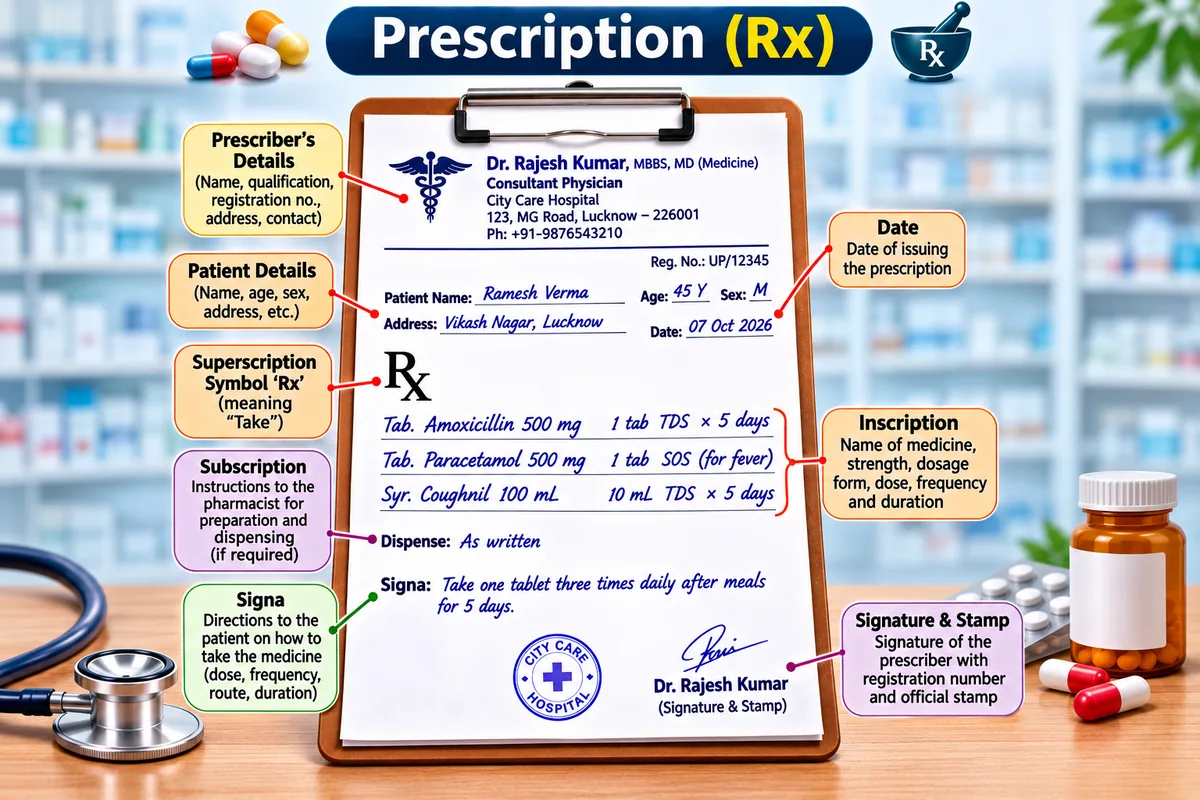
Simple Definition:
A Prescription is defined as a legal written order from a registered medical practitioner (doctor) to a registered pharmacist asking to prepare and dispense specific medicines to a patient.
The 8 Systematic Parts of a Prescription:
- 1. Prescriber's Information & Date: Doctor's name, qualification, clinic address, and date of writing. Date prevents illegal misuse of old prescriptions.
- 2. Patient's Information: Patient name, age, sex, weight, and address. Age and body weight are needed to calculate correct pediatric or geriatric doses.
- 3. Superscription (Rx):
- • It is also known as: The heading of the prescription (symbol Rx).
- • It is used for: Commencing the prescription, originating from the Latin word Recipe, meaning "Take thou" (you take this medicine).
- 4. Inscription (The Main Body):
- • It is also known as: The core formula or body of the prescription.
- • It is used for: Listing the exact names, active ingredients, and dosage strengths of the medicines (for example, Tab. Paracetamol 500 mg).
- 5. Subscription: Directions to the pharmacist on what dosage form to prepare and how many units to dispense (e.g., "Dispense 10 capsules").
- 6. Signatura (Sig.): Instructions for the patient on how to take the medicine (e.g., "Take 1 tablet twice a day after meals").
- 7. Refill Instructions: Mentions whether the patient can purchase the medicine again without a fresh doctor visit.
- 8. Signature & Registration Number: Doctor's legal signature and state medical council registration number.
9. Handling of Prescriptions (Step-by-Step Procedure)
When a prescription arrives at the pharmacy counter, the pharmacist must follow these 5 standard steps:
10. Latin Terminology Related to Prescriptions
Doctors use short Latin words on prescriptions. Here is the essential table every pharmacy student must know:
| Latin Phrase | Abbreviation | English Meaning |
|---|---|---|
| Semel in die | o.d. / s.i.d. | Once a day |
| Bis in die | b.i.d. | Twice a day |
| Ter in die | t.i.d. | Three times a day |
| Quater in die | q.i.d. | Four times a day |
| Statim | stat. | Immediately (right now) |
| Pro re nata | p.r.n. | As needed / when required |
| Ante cibos | a.c. | Before food / before meals |
| Post cibos | p.c. | After food / after meals |
| Hora somni | h.s. | At bedtime |
| Omni mane | o.m. | Every morning |
| Omni nocte | o.n. | Every night |
| Guttae | gutt. | Drops |
| Capsula | cap. | A capsule |
| Tabella | tab. | A tablet |
| Unguentum | ung. | An ointment |
| Mistura | mist. | A mixture |
| Fiat | ft. | Make / let it be made |
| Quantum sufficiat | q.s. | As much as needed (sufficient quantity) |