Monophasic and Biphasic Liquid Dosage Forms
Liquid medicines are liquid preparations containing active pharmaceutical ingredients dissolved or suspended in a suitable liquid vehicle. Liquid dosage forms are fast-acting, easy to swallow for children and elderly patients, and offer flexible dosing. In this guide, every syllabus topic is explained step-by-step using simple definitions, easy language, comparisons, and practical pharmaceutical examples.
In this topic, you will learn:
1. Monophasic Liquids for Internal Use (Oral Liquids)
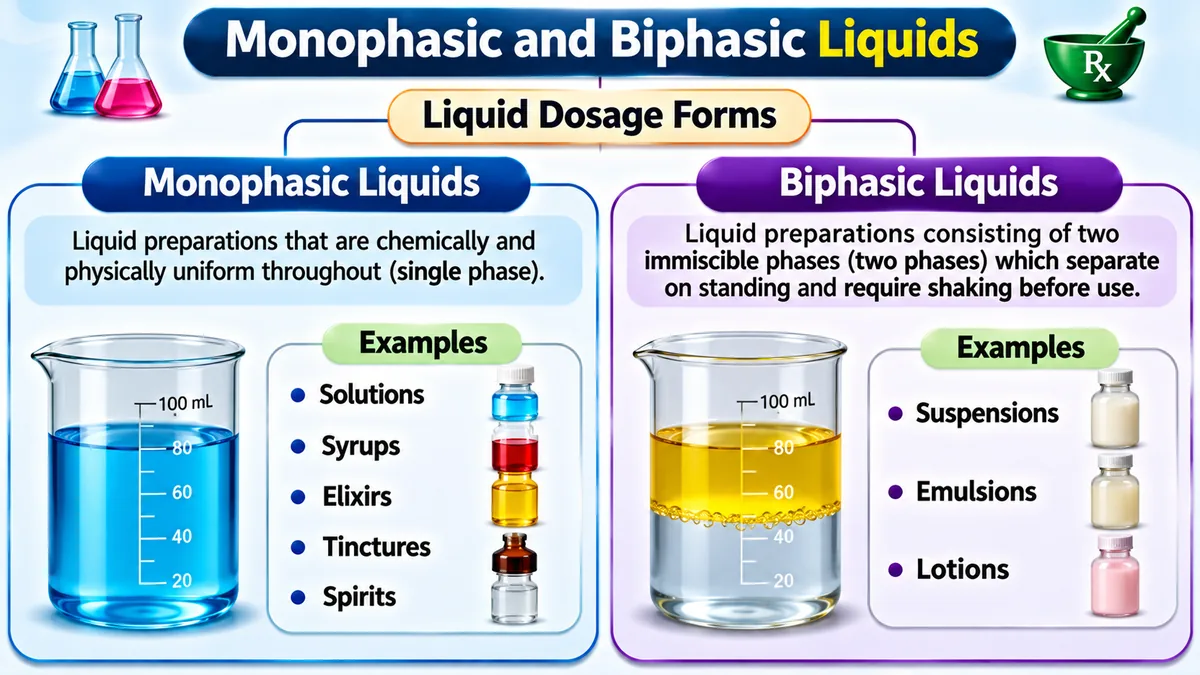
Simple Definition:
A Monophasic Liquid is defined as a single-phase liquid system where the drug (solute) is completely dissolved in the liquid vehicle (solvent) at a molecular level, giving a clear, uniform appearance with no visible solid particles.
Syrups (Simple Syrup IP)
A Syrup is defined as a concentrated, sweet, viscous aqueous solution of sugar (sucrose) in purified water.
- • It is also known as: Sweet oral viscous liquid dosage form.
- • It is used for: Masking the unpalatable, bitter taste of active drugs and administering medicines comfortably to children (pediatrics) and elderly patients (geriatrics).
- • For example: Paracetamol pediatric syrup, Dextromethorphan cough syrup.
• Simple Syrup IP: Contains 66.7% w/w sucrose in purified water.
• Simple Syrup USP: Contains 85.0% w/v sucrose in purified water.
Why Simple Syrup IP is Self-Preserving: At a high concentration of 66.7% w/w sugar, syrup has very high osmotic pressure. When bacteria or fungal spores enter the syrup, water is drawn out from their microbial cells by osmosis. Because microorganisms dehydrate and cannot live without free water, Simple Syrup IP stays preserved without adding chemical preservatives.
Method of Preparation: Weigh 667 g of sucrose and dissolve it in purified water by gentle heating on a water bath. Cool, filter through clean cotton wool, and adjust the final weight to 1000 g using purified water.
Elixirs
An Elixir is defined as a clear, pleasantly flavored, sweetened hydroalcoholic solution (containing 4% to 40% ethyl alcohol) intended for oral use.
- • It is also known as: Sweetened hydroalcoholic liquid dosage form.
- • It is used for: Dissolving and delivering active pharmaceutical ingredients that are insoluble in pure water, using alcohol as a co-solvent.
- • For example: Paracetamol Elixir (for fever), Phenobarbital Elixir (for sedation and seizures), Digoxin Elixir (for cardiac failure).
Alcohol acts as a co-solvent to keep water-insoluble medicinal substances dissolved. Glycerin and propylene glycol are often added as auxiliary solvents and sweetening agents.
• Non-medicated elixirs: Used as flavored vehicles (e.g., Aromatic Elixir).
• Medicated elixirs: Contain therapeutic drugs (e.g., Paracetamol Elixir, Phenobarbital Elixir).
Comparison with Syrups: Elixirs are less sweet and less viscous than syrups, but they dissolve a broader variety of drugs due to their alcohol content.
Aromatic Waters
Aromatic water is defined as a clear, saturated aqueous solution of volatile oils or other aromatic volatile substances (such as camphor, chloroform, or peppermint oil) in purified water.
Uses: Primarily used as pleasantly flavored vehicles for oral medicines and for carminative (gas-relieving) actions in the stomach.
• Camphor Water IP: Used as a carminative vehicle.
• Chloroform Water IP: Contains 0.25% v/v chloroform, used as a preservative vehicle.
• Peppermint Water: Relieves flatulence and gastric spasms.
Linctuses
A Linctus is defined as a viscous, sweet, syrup-based liquid medicine designed to soothe coughs and irritation in the throat.
Linctuses contain demulcents (syrup, glycerin) that coat the irritated mucosa of the pharynx.
Example: Codeine Linctus BPC (used as a dry cough suppressant).
2. Monophasic Liquids for External Use and Body Cavities
Medicines applied to skin surfaces or body cavities must be formulated specifically for their target site to ensure safety, comfort, and efficacy.
Comparison: Liniments vs. Lotions
| Property | Liniments | Lotions |
|---|---|---|
| Definition | Liquid preparations meant to be rubbed into the skin with friction. | Liquid preparations meant to be applied to the skin without friction. |
| Method of Application | Rubbed vigorously on the skin with friction using hands. | Dabbed gently onto the skin using cotton wool or gauze without rubbing. |
| Vehicle Type | Oily vehicle (vegetable oil) or alcoholic base to aid skin penetration. | Aqueous (water-based) or dilute alcohol vehicle that evaporates to produce cooling. |
| Therapeutic Action | Counter-irritant, rubefacient, and pain reliever for joints and muscles. | Soothing, cooling, protective, and anti-pruritic (anti-itching) effect. |
| Application on Broken Skin | Strictly contraindicated! Causes extreme burning pain and irritation. | Safe to apply on inflamed, sunburned, or broken skin. |
| Official Examples | Turpentine Liniment IP, Camphor Liniment | Calamine Lotion IP |
Throat Paints
A Throat Paint is defined as a viscous liquid preparation applied directly to the mucous membrane of the throat with a soft camel-hair brush.
Role of Glycerin: Glycerin is used as the vehicle because its high viscosity makes the medicine stick to the throat lining, ensuring long contact time.
Applications
An Application is defined as a liquid or semi-liquid preparation containing active medicinal agents applied directly to the skin for parasiticide or antiseptic action.
They are usually oily or aqueous emulsions formulated for easy spreadability.
Gargles
A Gargle is defined as an aqueous concentrated solution used to treat and prevent infections in the pharynx and throat.
They are supplied in concentrated form and must be diluted with warm water before use. They are gargled in the back of the throat and then spat out (not swallowed).
Mouthwashes
A Mouthwash is defined as an aqueous solution with a pleasant taste and odor used to cleanse and deodorize the oral cavity.
Mouthwashes contain antibacterial agents, astringents (zinc salts), and flavoring agents to freshen breath and fight gum gingivitis. Swished in the mouth and expelled.
Enemas (Evacuant vs. Retention)
An Enema is defined as a liquid preparation introduced into the rectum and colon via the anus for therapeutic, diagnostic, or bowel-cleansing purposes.
Large volumes (500 mL to 1000 mL) administered to stimulate peristalsis and evacuate the bowel before surgery or childbirth (e.g., Soap Enema, Saline Enema).
Small volumes (50 mL to 150 mL) designed to be retained in the rectum for systemic drug absorption (e.g., Prednisolone enema for ulcerative colitis, Paralysed nutrition).
3. Specialized Instillations (Eye, Ear, Nasal Drops) and Tinctures
Eye Drops (Ophthalmic Solutions)
An Eye Drop is defined as a sterile aqueous or oily solution or suspension of drugs intended for instillation into the conjunctival sac of the eye.
• Strict Sterility: Must be completely free of microorganisms (especially Pseudomonas aeruginosa which causes eye blindness).
• Isotonicity: Must be isotonic with tears (equivalent to 0.9% w/v NaCl) to prevent stinging and tearing.
• Buffering: pH maintained close to 7.4 (lachrymal fluid pH).
• Preservatives: Benzalkonium chloride (0.01% w/v) or Phenylmercuric nitrate (0.002% w/v).
Example: Ciprofloxacin Eye Drops IP, Timolol Maleate Eye Drops IP (for glaucoma).
Ear Drops (Otic Solutions)
An Ear Drop is defined as a solution or suspension of drugs formulated in glycerin, propylene glycol, alcohol, or vegetable oil for instillation into the ear canal.
• Viscous Vehicle: Glycerin or propylene glycol is preferred because it adheres to the vertical ear canal wall and softens hardened ear wax (cerumen).
• Uses: To treat ear infections, relieve inflammation, and dissolve ear wax plugs.
Example: Chloramphenicol Ear Drops IP, Paradichlorobenzene Ear Drops (earwax softener).
Nasal Drops
A Nasal Drop is defined as an aqueous solution of drugs intended for instillation into the nasal passages to treat congestion and mucosal inflammation.
• Physiological Compatibility: Must be isotonic (0.9% NaCl) and buffered to pH 5.5 to 6.5 to preserve normal ciliary motility.
• Why Oily Vehicles are Avoided: Mineral oils can drip into the lungs and cause lipoid pneumonia; therefore, nasal vehicles must be aqueous.
Example: Xylometazoline Nasal Drops IP, Oxymetazoline Drops (decongestants).
Tinctures
A Tincture is defined as an alcoholic or hydroalcoholic extract prepared from crude vegetable drugs or chemical substances.
• Strength: 100 mL of tincture typically represents the active principles of 10 g to 20 g of dried crude drug.
• Preparation Methods: Prepared by maceration (soaking) or percolation (filtering solvent through drug bed).
Examples: Tincture of Iodine IP (antiseptic for cuts), Compound Benzoin Tincture IP (Friar's Balsam for steam inhalation).
4. Study of Official Liquid Preparations: Excipients & Preparation Methods
In official pharmacopoeias (IP, BP, USP), liquid preparations are formulated using specialized excipients to guarantee physical, chemical, and microbiological stability.
| Excipient Class | Primary Function | Common Pharmacopoeial Examples |
|---|---|---|
| Vehicles (Solvents) | Dissolves or disperses the drug substances in the formulation. | Purified Water IP, Alcohol, Glycerin, Propylene glycol. |
| Preservatives | Prevents microbial growth, mold, and bacterial spoilage. | Methylparaben (0.15%), Propylparaben (0.02%), Sodium benzoate (0.1%). |
| Antioxidants | Protects oxidizable drugs from degradation by oxygen exposure. | Sodium metabisulfite, Ascorbic acid, Butylated hydroxytoluene (BHT). |
| Buffers | Maintains constant optimal pH for drug stability and tissue comfort. | Phosphate buffer, Citrate buffer, Borate buffer. |
| Viscosity Enhancers | Slows particle settling in suspensions and coats mucosal tissues. | Methylcellulose, Sodium carboxymethylcellulose (Na-CMC), Acacia. |
| Flavors & Sweeteners | Masks bitter or unpleasant drug taste for patient compliance. | Sucrose, Sorbitol, Sodium saccharin, Peppermint oil, Orange syrup. |
The solid solute is dissolved directly in the solvent by gentle stirring (e.g., Simple Syrup IP, Normal Saline Solution 0.9%).
Two or more chemical ingredients react together in solution to produce the active compound (e.g., Lugol's Iodine Solution: I₂ + KI → KI₃ complex).
Soluble principles of crude drugs are extracted using alcohol or water for a specific period (e.g., Compound Cardamom Tincture).
5. Suspensions: Theory, Stokes' Law & Formulation
Simple Definition:
A Pharmaceutical Suspension is defined as a biphasic liquid dosage form in which finely divided insoluble solid drug particles (dispersed phase, 0.5–5 μm) are uniformly distributed throughout a liquid vehicle (continuous phase).
- • It is also known as: Coarse liquid dispersion.
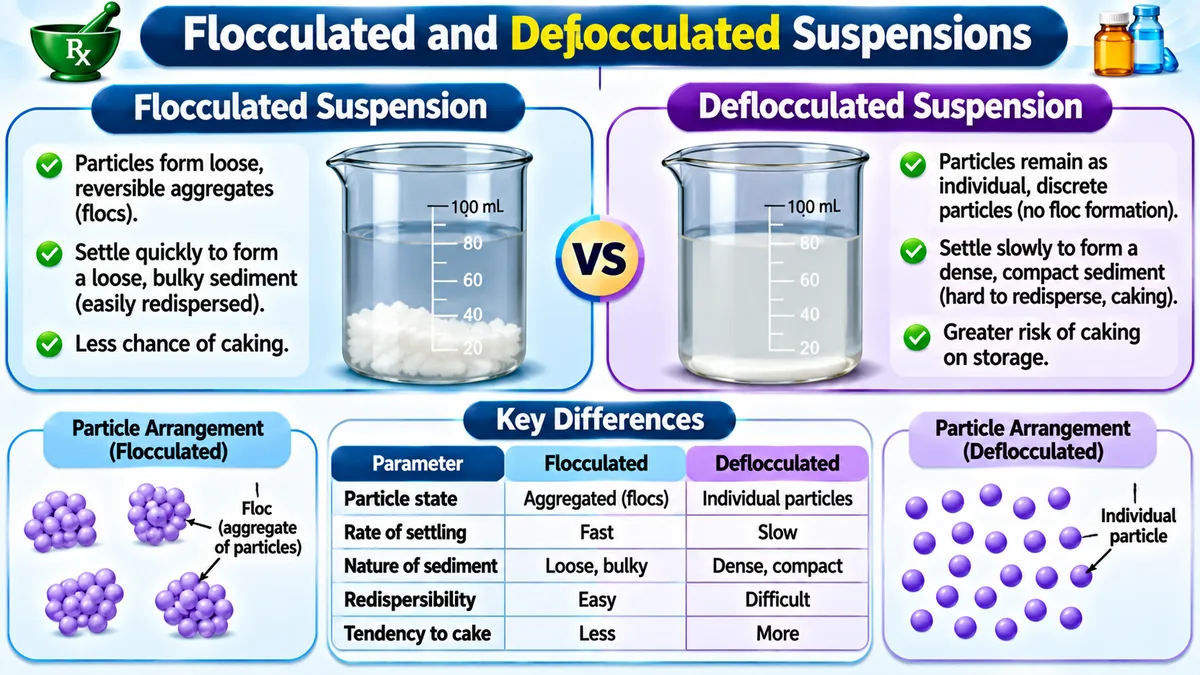
- • It is of two types: Flocculated suspensions (loose flocs, rapid sedimentation, easy redispersion) and Deflocculated suspensions (slow sedimentation, forms hard irreversible cake).
- • It is used for: Administering insoluble drugs in liquid form, improving drug stability, and controlling release rate.
Simple Definition:
A Suspension is defined as a biphasic, heterogeneous liquid dosage form in which insoluble solid active drug particles (called the dispersed phase) are uniformly suspended throughout a liquid vehicle (called the continuous phase).
Advantages of Suspensions:
- Enables liquid administration of water-insoluble drugs.
- Masks bitter taste of drugs (e.g., Chloramphenicol palmitate suspension has no bitter taste).
- Higher chemical stability than solutions (insoluble drug degrades much slower).
- Provides sustained drug release and prolonged therapeutic action.
Disadvantages of Suspensions:
- Physical instability: solid particles tend to settle down over time due to gravity.
- Dosing errors can happen if the patient forgets to shake the bottle well before pouring.
- Bulky and harder to transport compared to dry solid tablets.
- Uniformity of dose requires careful formulation design.
Stokes' Law (How Fast Particles Settle Down):
In physics and pharmaceutics, Stokes' law governs the sedimentation velocity (settling rate, v) of spherical solid particles suspended in a liquid:
How Pharmacists Prevent Fast Sedimentation (Using Stokes' Law):
1. Reduce particle diameter (d): Since velocity depends on the square of diameter (d²), micronizing particles by ball milling dramatically slows down settling.
2. Increase vehicle viscosity (η): Adding suspending agents (like Tragacanth or Methylcellulose) makes the liquid thicker, reducing settling velocity v.
3. Match densities (ρs ≈ ρ₀): Adding sugar or sorbitol increases the vehicle density, narrowing the difference (ρs - ρ₀).
Flocculated vs. Deflocculated Suspensions
| Property | Flocculated Suspension (Desirable) | Deflocculated Suspension (Undesirable) |
|---|---|---|
| Particle Organization | Particles join into loose, porous clusters called flocs. | Particles exist as separate, independent individual units. |
| Rate of Sedimentation | Rapid settling because flocs have large effective diameter. | Slow settling because individual particles are very tiny. |
| Sediment Nature & Cake Formation | Loose, porous sediment. Does NOT form a hard cake. | Forms a rock-hard, compact caking (clay) at the bottom. |
| Redispersibility on Shaking | Easily and uniformly redispersed with simple, gentle shaking. | Impossible to redisperse even with vigorous shaking. |
| Supernatant Liquid Appearance | Clear supernatant liquid above the settled flocs. | Turbid, cloudy supernatant liquid that remains cloudy. |
- Wetting Agents: Reduce interfacial tension between hydrophobic drug and water (e.g., Polysorbate 80, Sodium lauryl sulfate, Glycerin).
- Suspending Agents: Increase viscosity (e.g., Acacia, Tragacanth, Xanthan gum, Methylcellulose).
- Flocculating Agents: Control zeta potential to form loose flocs (e.g., Sodium chloride, Potassium phosphate).
- Preservatives: Prevent microbial growth (Methylparaben, Sodium benzoate).
- Particle Size Reduction: Triturate drug to fine powder in a mortar.
- Wetting: Mix drug powder with wetting agent to form smooth paste.
- Mucilage Addition: Add suspending agent mucilage in portions with steady trituration.
- Vehicle & Volume: Add liquid vehicle to bring to final volume.
- Homogenization: Pass through a colloid mill to achieve uniform dispersion.
6. Emulsions: Types, Identification Tests, Preparation & Stability
Simple Definition:
A Pharmaceutical Emulsion is defined as a biphasic liquid dosage form consisting of two immiscible liquids (oil and water), where one liquid is dispersed as fine globules inside the other, stabilized by a third substance called an emulsifying agent (emulgent).
- • It is of two primary types: 1) Oil-in-Water (O/W) emulsion (oil globules dispersed in water continuous phase), and 2) Water-in-Oil (W/O) emulsion (water droplets dispersed in oil continuous phase).
- • Identification Tests: Dilution test, Dye test (Scarlet Red), Conductivity test, and Fluorescence test.
- • It is used for: Formulating oils and vitamins for oral administration and creating soothing topical creams.
Simple Definition:
An Emulsion is defined as a biphasic liquid system consisting of two immiscible liquids (usually oil and water), where one liquid is dispersed as tiny droplets (dispersed phase) throughout the second liquid (continuous phase), stabilized by an Emulsifying Agent (Emulgent).
1. Oil-in-Water (O/W) Emulsion
Tiny droplets of oil are dispersed inside a continuous water phase.
- Preferred for oral consumption because the outer water phase masks unpalatable oily tastes (e.g., Castor Oil Emulsion, Cod Liver Oil Emulsion).
- Used for external vanishing creams that wash away easily with water.
- Formulated with water-soluble emulsifiers like Acacia, Tragacanth, and Tween 80.
2. Water-in-Oil (W/O) Emulsion
Tiny droplets of water are dispersed inside a continuous oil phase.
- Preferred for external application to dry skin (e.g., Cold creams, barrier creams).
- Forms an occlusive, oily protective layer that retains moisture in the skin.
- Formulated with oil-soluble emulsifiers like Wool fat (lanolin), beeswax, Span 80, and divalent metallic soaps.
Emulsifying Agents & The HLB Scale
An emulsifying agent forms a protective mechanical or electrical barrier around the dispersed droplets to prevent them from colliding and coalescing back into a single bulk layer.
The HLB (Hydrophilic-Lipophilic Balance) Concept: Griffin established an arbitrary numerical scale from 0 to 20 representing the balance of hydrophilic (water-loving) and lipophilic (oil-loving) groups on a surfactant molecule:
4 Pharmacopoeial Identification Tests for Emulsion Type
Dilute the emulsion with a few drops of water. If the water mixes smoothly without breaking the emulsion, it is O/W. If the emulsion breaks or oil separates, it is W/O.
Mix a tiny speck of a water-soluble dye (Amaranth red or Methylene blue). Under a microscope, if the continuous background turns colored while droplets stay clear, it is O/W. If droplets are red, it is W/O.
Dip two electrodes connected to an electric lamp into the emulsion. If the lamp glows, it is O/W (because the continuous water phase conducts electricity). If it does not light, it is W/O.
Examine the emulsion under ultraviolet (UV) light. Oils exhibit characteristic fluorescence under UV. If the whole field fluoresces evenly, it is W/O. If only spotty droplets fluoresce, it is O/W.
Classic Methods of Preparation of Emulsions
In compounding pharmacy, emulsions containing fixed oils or volatile oils are prepared using the famous Oil : Water : Gum (Acacia) primary emulsion ratios:
Fixed Oil Ratio: 4 : 2 : 1 (Oil:Water:Gum).
Triturate 4 parts oil with 1 part dry acacia gum in a dry mortar until smooth. Then add 2 parts water all at once and triturate vigorously until a clicking sound is heard and a creamy white primary emulsion forms.
Fixed Oil Ratio: 4 : 2 : 1 (Oil:Water:Gum).
Triturate 1 part acacia gum with 2 parts water first to make a smooth mucilage. Then add 4 parts oil in very small, gradual increments, triturating continuously after each addition until the primary emulsion forms.
Volatile Oil Ratio: 2 : 2 : 1 or 3 : 2 : 1.
Used for volatile, low-viscosity oils (e.g., Peppermint oil, Turpentine oil). Put dry gum and oil into a dry bottle, shake thoroughly, add water all at once, and shake vigorously.
Instabilities in Emulsions (What Can Go Wrong)
Dispersed oil droplets rise to the top surface (or sink) forming a concentrated layer, like cream on milk. Reversible: redisperses easily with gentle shaking.
The protective surfactant film around droplets is destroyed. The oil and water completely separate into two distinct bulk layers. Irreversible: cannot be fixed by shaking.
An O/W emulsion flips into a W/O emulsion (or vice versa) caused by changes in temperature, addition of divalent ions (Ca²⁺), or altering phase volume ratio.
Flocculation is reversible droplet grouping; coalescence is the irreversible merging of small droplets into larger droplets preceding cracking.