Pharmaceutical Calculations, Posology & Dosage Forms
Accurate mathematical calculations are the backbone of compounding and dispensing medicines. A single calculation error can lead to under-dosing or fatal toxicity. In this lecture guide, we cover every topic heading-by-heading: the metric system, scientific notation, alligation calculations, proof spirit, isotonic solutions, dilution calculations, geometric dilution, posology formulas (age, weight, BSA), routes of drug administration, dosage form classification, and APIs & excipients.
1. Metric System of Weights and Measures
The Metric System is defined as the official international decimal system of measurement based on units of 10, recognized by the Indian Pharmacopoeia and world health bodies.
- • It is also known as: The International System of Units (SI decimal system).
- • It is used for: Accurately weighing minute drug doses in grams (g), milligrams (mg), and micrograms (μg), and measuring liquid volumes in liters (L) and milliliters (mL).
- • For example: Paracetamol 500 mg tablet, Cough syrup 100 mL bottle.
A. Measures of Weight (Mass)
- • 1 Kilogram (kg) = 1,000 grams (g)
- • 1 Gram (g) = 1,000 milligrams (mg)
- • 1 Milligram (mg) = 1,000 micrograms (μg or mcg)
- • 1 Microgram (μg) = 1,000 nanograms (ng)
B. Measures of Capacity (Volume)
- • 1 Liter (L) = 1,000 milliliters (mL)
- • 1 Milliliter (mL) = 1,000 microliters (μL)
- • 1 Cubic centimeter (cm³ or cc) ≈ 1 mL
- • 1 Drop (gutta) ≈ 0.05 mL (20 drops make 1 mL)
2. Scientific Notation of Units and Measures
Simple Definition:
Scientific Notation is defined as a convenient mathematical way of writing very large or very small numbers using powers of 10 in the format: N × 10ⁿ (where N is a number between 1 and 10, and n is an integer exponent).
| Standard Value | Scientific Notation | Pharmaceutical Application |
|---|---|---|
| 0.000001 g (1 μg) | 1.0 × 10⁻⁶ g | Low-dose hormones, Vitamin B12, Fentanyl. |
| 0.001 g (1 mg) | 1.0 × 10⁻³ g | Potent tablet active ingredients (e.g., Amlodipine 5 mg). |
| 1,000 g (1 kg) | 1.0 × 10³ g | Bulk manufacturing raw material batch sizes. |
3. Calculations Based on Alligation (Medial & Alternate)
Simple Definition:
Alligation is defined as a rapid calculation method used to find the average strength when mixing solutions of known strengths (Alligation Medial) or to find the proportions in which solutions of different strengths must be mixed to prepare a desired intermediate strength (Alligation Alternate).
Used to find the resulting average strength when given quantities of different strengths are mixed together.
Used to find how many parts of a stronger and weaker solution must be mixed to get a desired new strength.
Question: In what proportions must 90% alcohol and 50% alcohol be mixed to prepare 500 mL of 70% alcohol?
Step 1: Set up the Alligation Grid
• Higher % (90%) → (70 - 50) = 20 parts of 90% alcohol
• Desired % (70%) in center
• Lower % (50%) → (90 - 70) = 20 parts of 50% alcohol
• Ratio of 90% : 50% = 20 : 20 = 1 : 1 (Total = 40 parts)
Step 2: Calculate volume for 500 mL batch
• 90% alcohol = (20 / 40) × 500 mL = 250 mL
• 50% alcohol = (20 / 40) × 500 mL = 250 mL
Answer: Mix 250 mL of 90% alcohol with 250 mL of 50% alcohol to make 500 mL of 70% alcohol.
4. Calculations Based on Proof Spirit
Simple Definition:
Proof Spirit is defined as a legal alcohol-water mixture used for government excise tax calculation. In India, 100° Proof spirit contains 57.1% v/v of pure absolute ethyl alcohol at 60°F.
• Any alcohol stronger than 57.1% v/v is called Over Proof (O.P.).
• Any alcohol weaker than 57.1% v/v is called Under Proof (U.P.).
• 57.1% v/v = 100° Proof → 1% v/v alcohol = (100 / 57.1) = 1.753° Proof.
Proof = (80 × 1.753) - 100 = 140.24 - 100
= +40.24° O.P. (Over Proof)
Proof = (30 × 1.753) - 100 = 52.59 - 100
= -47.41° U.P. (Under Proof)
5. Calculations Based on Isotonic Solutions
Simple Definition:
An Isotonic Solution is defined as a solution that has the exact same osmotic pressure as human blood plasma and tears. 0.9% w/v Sodium Chloride solution is isotonic with human blood and has a freezing point depression (ΔTf) of -0.52°C.
Methods for Adjusting Isotonicity:
Blood freezing point depression is 0.52°C. The formula to find weight (W) in g per 100 mL of adjusting substance (NaCl) is:
Where a = freezing point depression of drug; b = depression of 1% adjusting substance (for NaCl, b = 0.58°C).
The E-value is the amount of NaCl that creates the same osmotic pressure as 1.0 g of the drug.
Where V = volume of solution in mL.
6. Calculations Based on Dilute Solutions (Percentage, Ratio, PPM)
• % w/v: g of solid in 100 mL liquid.
• % v/v: mL of liquid in 100 mL liquid.
• % w/w: g of solid in 100 g product.
Expressed as 1 in 1,000 (meaning 1 g in 1,000 mL = 0.1% w/v), or 1 in 5,000 (meaning 1 g in 5,000 mL).
Used for very tiny impurities (like heavy metals): 1 PPM = 1 part of substance in 1,000,000 parts of solution (1 mg per liter).
(Initial Concentration × Initial Volume = Final Concentration × Final Volume)
7. The Geometric Dilution Method
Simple Definition:
Geometric Dilution is defined as a step-by-step mixing method used when a very small amount of a potent active drug must be mixed uniformly with a large amount of an inactive powder (like lactose or starch).
Step-by-Step Procedure:
1. Weigh the potent drug (e.g., 100 mg) and place it in a clean mortar.
2. Add an equal quantity of diluent powder (100 mg) and triturate thoroughly with the pestle.
3. Now the mixture in the mortar is 200 mg. Add another 200 mg of diluent and mix again.
4. Continue doubling the volume step-by-step until all the diluent is uniformly mixed.
Importance: Ensures every single tablet or divided powder contains the exact same active drug dose without hot-spots.
8. Posology: Definition & Factors Affecting Drug Dose
Simple Definition:
Posology is defined as the branch of medical and pharmaceutical science that deals with the quantitative determination of the correct dose of medicine needed to produce the desired healing effect safely without causing toxicity.
Major Factors Influencing Dose Selection:
9. Dose Calculations Based on Age (Young's, Dilling's, Fried's Rules)
| Rule Name | Patient Category | Formula | Worked Example (Adult Dose = 500 mg) |
|---|---|---|---|
| Young's Rule | Children 1 to 12 years | Child Dose = [Age / (Age + 12)] × Adult Dose | For 6 yr child: [6 / (6+12)] × 500 = (6/18) × 500 = 166.7 mg |
| Dilling's Rule | Children 4 to 20 years | Child Dose = (Age / 20) × Adult Dose | For 6 yr child: (6 / 20) × 500 = 150 mg |
| Fried's Rule | Infants under 2 years | Infant Dose = (Age in months / 150) × Adult Dose | For 9 month infant: (9 / 150) × 500 = 30 mg |
10. Dose Calculations Based on Body Weight (Clark's Rule)
Clark's Rule Formula:
Child Dose = (Weight of child in pounds / 150) × Adult Dose
(If weight is in kilograms: Child Dose = [Weight in kg / 70] × Adult Dose, assuming standard adult weight is 70 kg).
Child Dose = (45 / 150) × 600 mg = 0.30 × 600 = 180 mg.
11. Dose Calculations Based on Body Surface Area (BSA)
Dose calculation based on Body Surface Area (BSA) is the most accurate method in medicine because surface area reflects heart output and kidney filtration rate. It is strictly used for anticancer chemotherapy and potent antibiotics.
BSA Formula (Average adult BSA = 1.73 m²):
12. Introduction to Dosage Forms: Routes of Administration
A drug can enter the body through several pathways. The route is chosen depending on how fast action is needed, the chemical nature of the drug, and patient condition:
13. Classification of Dosage Forms (By Physical State)
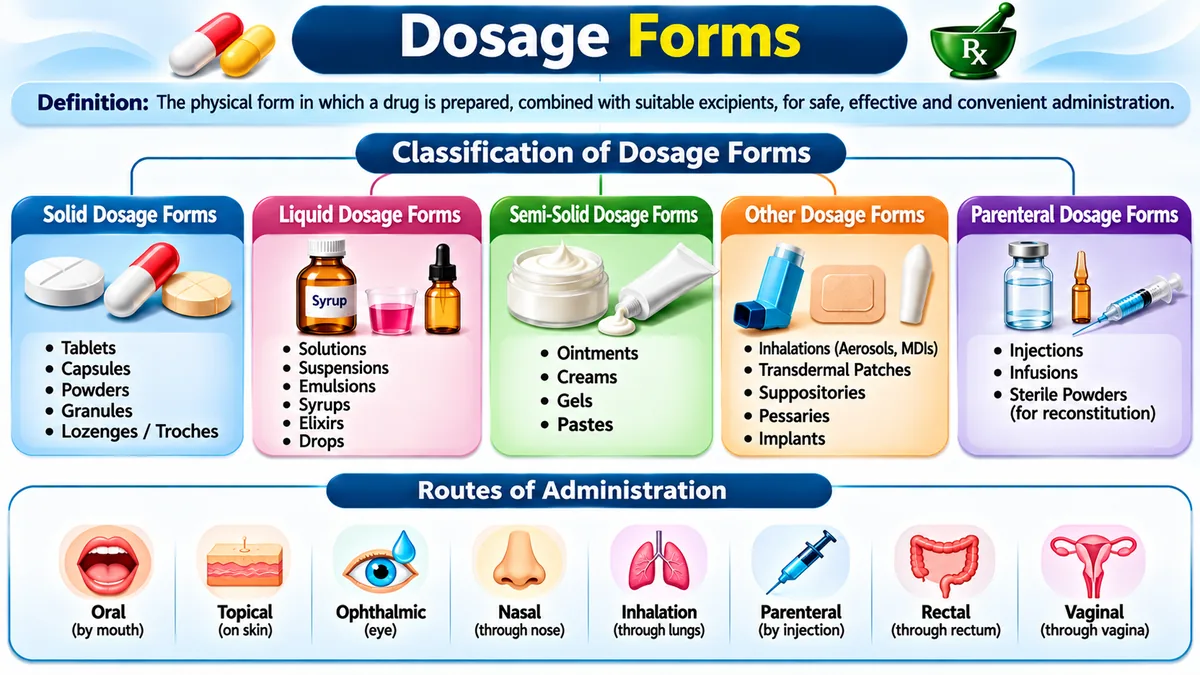
Simple Definition:
A Dosage Form is defined as the final physical form (such as tablet, capsule, syrup, or ointment) in which a drug is presented for clinical use by a patient.
- • Tablets
- • Capsules
- • Powders
- • Pills / Lozenges
- • Syrups & Elixirs
- • Suspensions
- • Emulsions
- • Injections (IV/IM)
- • Ointments
- • Pastes
- • Creams & Gels
- • Suppositories
- • Aerosol Sprays
- • Inhalers (MDIs)
- • Nebulizer Solutions
- • Anesthetic Gases
14. Active Pharmaceutical Ingredients (APIs): Definition, Characteristics & Importance
Simple Definition:
An Active Pharmaceutical Ingredient (API) is defined as the biologically active chemical substance in a medicine that produces the direct pharmacological effect to cure, diagnose, or treat a disease (e.g., Paracetamol, Ibuprofen, Amoxicillin).
- High Purity: Must conform to strict pharmacopoeial purity limits (usually ≥ 99.0%).
- Chemical Stability: Must remain stable against heat, light, and humidity during shelf-life.
- Reproducible Bioavailability: Must dissolve reliably in stomach or intestinal fluids.
- Importance: Without the API, a tablet or injection has zero therapeutic value; the API is the core medicinal agent.
15. Pharmaceutical Excipients: Definition, Characteristics & Classification
Simple Definition:
A Pharmaceutical Excipient is defined as any non-active substance intentionally added alongside the active drug (API) to help in manufacturing, give shape, improve stability, mask bitter taste, or assist drug release in the body.
| Excipient Class | Primary Role (Simple Explanation) | Official Examples |
|---|---|---|
| Diluent (Bulking Agent) | Adds weight/bulk so a tiny 5 mg drug powder can be made into a handheld tablet. | Lactose, Microcrystalline cellulose (Avicel), Starch |
| Binder (Adhesive) | Acts like glue to bind powder particles into strong granules. | PVP (Povidone K-30), Acacia gum, Starch paste |
| Disintegrant | Swells and breaks the tablet quickly into tiny pieces inside gastric juice. | Sodium Starch Glycolate, Croscarmellose Sodium |
| Lubricant & Glidant | Prevents powder sticking to tablet dies and improves powder flow from hopper. | Magnesium Stearate, Talc, Colloidal Silicon Dioxide |
| Preservative | Prevents bacterial and fungal growth in liquid syrups and eye drops. | Methylparaben, Propylparaben, Sodium Benzoate |