Solid Dosage Forms: Powders, Tablets & Capsules
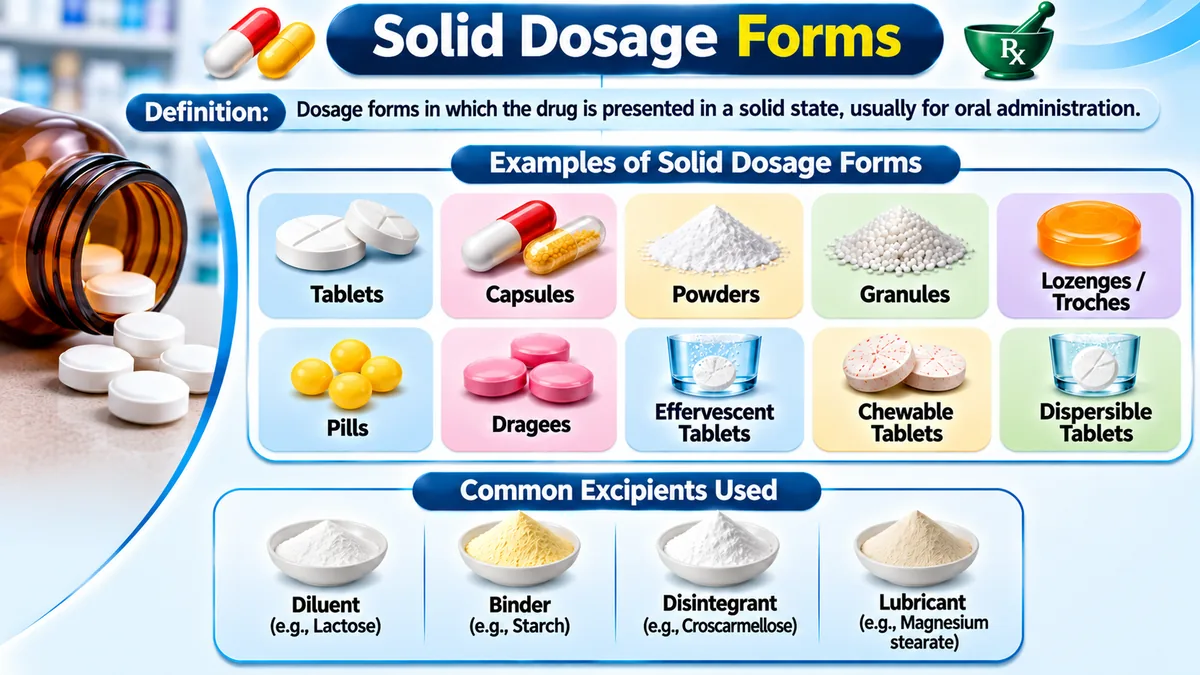
Solid dosage forms represent over 70% of all medicines manufactured worldwide. They provide exact unit dosing, high chemical stability, and convenient portability. In this lecture guide, we cover every topic heading-by-heading: powders (classification, dusting, effervescent, efflorescent, hygroscopic, eutectic mixtures, excipients and preparation), tablets (types, moulded tablets, pills, excipients, and wet/dry granulation), and capsules (hard vs soft gelatin, capsule sizes 000 to 5, excipients and filling).
1. Powders: Definition, Classification, Advantages & Disadvantages
Pharmaceutical Powders (In Simple Words):
A Pharmaceutical Powder is defined as a solid dosage form consisting of finely divided, dry solid particles of one or more active drugs with or without excipients, intended for internal oral or external topical use.
- • It is also known as: Pulvis.
- • It is used for: Rapid therapeutic dissolution, flexible individualized dosing for pediatric/geriatric patients, and formulating dusting powders or effervescent drinks.
- • In this method, we: Reduce particle size by pulverization (trituration in mortar and pestle), pass through standard sieves, and mix uniformly using geometric dilution.
- • For example: Oral Rehydration Salts (ORS) powder and Neosporin antibiotic topical dusting powder.
- Higher chemical stability compared to liquid syrups and solutions.
- Faster dissolution and absorption in stomach because fine particles have high surface area.
- Easy to give to children and elderly patients who cannot swallow tablets.
- Allows custom dose mixing for multiple drugs.
- Bitter, nauseating, or unpleasant taste cannot be masked easily.
- Atmospheric moisture can make powders damp and degrade them.
- Bulk powders have less accurate dosing compared to factory-made tablets.
Classification of Powders:
• Divided Powders: Single doses wrapped in folded paper (e.g., Aspirin powder papers).
• Bulk Powders: Multi-dose powders in wide jars where dose is not strictly potent (e.g., Antacid powders, Laxatives).
• Dusting Powders: For skin application.
• Insufflations: Blown into nose, ear, or throat with an insufflator.
• Dentifrices: Tooth powders for cleaning teeth.
2. Special Classes of Powders
A. Dusting Powders
A Dusting Powder is defined as a fine medicinal powder meant for external application to the skin to provide soothing, absorbent, or antiseptic action (passed through Sieve No. 85 or 120).
• Medical Dusting Powders: For unbroken skin rashes (e.g., Talc, Zinc oxide).
• Surgical Dusting Powders: Applied to deep open wounds and burns; must be completely sterile (dry heat sterilized at 160°C for 2 hours) to avoid tetanus infection.
B. Effervescent Powders
An Effervescent Powder is defined as a mixture of active drug formulated with Citric acid, Tartaric acid, and Sodium bicarbonate.
When dissolved in water, an acid-base reaction occurs that fizzes and liberates Carbon Dioxide (CO₂) gas:Acid + NaHCO₃ → Sodium Salt + H₂O + CO₂↑The bubbling CO₂ masks unpleasant bitter taste and makes the drink refreshing (e.g., Eno).
C. Efflorescent Powders
An Efflorescent Powder is defined as a crystalline hydrated salt that gives up its water of crystallization to dry air (low humidity), causing the powder to become damp, pasty, and lose its dry crystalline structure (e.g., Sodium carbonate, Ferrous sulphate).
Storage: Dispense in airtight sealed glass bottles.
D. Hygroscopic & Deliquescent Powders
• Hygroscopic Powders: Absorb moisture from the atmosphere without dissolving into liquid (e.g., Pepsin, Ephedrine sulphate).
• Deliquescent Powders: Absorb so much atmospheric moisture that they dissolve completely in their own water and turn into a liquid solution (e.g., Calcium chloride, Potassium citrate).
Storage: Pack in double wax paper packets or hermetically sealed containers with silica gel.
3. Eutectic Mixtures
Simple Definition:
A Eutectic Mixture is defined as a mixture of two or more solid chemical substances (such as Camphor, Menthol, Thymol, Phenol, or Salol) that lower each other's melting point so that the mixture liquefies (turns into a liquid or damp paste) when mixed together at room temperature.
Method of Inert Adsorbent: Mix each eutectic substance separately with an equal quantity of an inert, fine adsorbing powder like Light Magnesium Carbonate, Starch, Talc, or Kaolin. Then gently combine the two diluted powders together using a spatula without heavy pressure (spatulation). The inert powder absorbs the moisture and keeps the powder dry.
4. Excipients & Methods of Preparation of Powders
Common Excipients in Powders: Diluents (Lactose, Starch), Glidants (Talc), and Adsorbents (Magnesium oxide).
5. Tablets: Definition, Advantages & Disadvantages
Simple Definition:
A Tablet is defined as a solid unit dosage form prepared by compressing or moulding a medicinal drug with suitable pharmaceutical excipients (diluents, binders, disintegrants, lubricants).
- • It is also known as: Compressed unit solid dosage form.
- • It is responsible for: Delivering an exact, accurate dose of medication in a compact, stable, and convenient oral form.
- • Types of Tablets: Oral tablets, chewable, effervescent, sublingual/buccal, enteric-coated, and sustained-release tablets.
Pharmaceutical Tablets (In Simple Words):
A Tablet is defined as a solid unit dosage form containing one or more active pharmaceutical ingredients (APIs) with suitable excipients, prepared by compressing uniform granular powder mixes into solid discs.
- • It is also known as: Compressed solid unit dose.
- • It is used for: Precise, tamper-evident, highly stable oral drug delivery with exact dosing and convenient self-administration.
- • In this method, we: Granulate powders (wet or dry granulation) to ensure free flow and compressibility, blend with lubricants, and compress on a high-speed rotary tablet machine.
- • For example: Paracetamol 500 mg antipyretic tablets and Disprin effervescent tablets.
- Exact, accurate unit dose in every tablet.
- Convenient and easy to carry, store, and swallow.
- Bitter drug taste can be masked by sugar coating or film coating.
- Cheap and suitable for mass production in industrial machines.
- Slow onset of action compared to IV injections and liquid syrups.
- Difficult to swallow for unconscious patients and infants.
- Some drugs can cause gastric stomach irritation (e.g., Aspirin).
6. Types of Tablets, Moulded Tablets & Pills
| Tablet Type | Defining Feature (Simple Explanation) | Official Examples |
|---|---|---|
| Standard Compressed | Swallowed whole with water; disintegrates in stomach within 15 minutes. | Paracetamol Tablets IP |
| Chewable Tablets | Chewed in the mouth before swallowing; formulated with sweet mannitol base. | Antacid Tablets (Digene), Albendazole |
| Dispersible Tablets | Disintegrates in water within 3 minutes forming a uniform suspension for easy drinking. | Amoxicillin Dispersible, Disprin |
| Sublingual Tablets | Placed under the tongue; rapid mucosal absorption directly into jugular vein, avoiding liver breakdown. | Nitroglycerin (for angina chest pain) |
| Buccal Tablets | Placed between the cheek and gum for slow systemic absorption. | Fentanyl Buccal Tablets |
| Enteric-Coated Tablets | Coated with acid-resistant polymer (Cellulose Acetate Phthalate) that resists stomach acid (pH 1-3) and dissolves in intestine (pH ≥ 6). | Enteric Aspirin, Pantoprazole |
| Sugar-Coated Tablets | Multi-layer sucrose coating to completely mask bitter taste and bad odor. | Ibuprofen, Multivitamin tablets |
| Moulded Tablets (Tablet Triturates) | Small, soft, flat tablets prepared by pressing moist mass into peg moulds (not compressed); dissolves very quickly. | Potent drug triturates (Atropine sulphate) |
| Pills | Small, round, spherical solid bodies prepared by rolling a mass and cutting into globes (precursor to modern tablets). | Ayurvedic Vati / Traditional herbal pills |
7. Excipients Used in Tablets
8. Methods of Preparation of Tablets
Directly compressing powder blends into tablets without any granulation. Suitable only for free-flowing, compressible powders like Avicel PH-102 or spray-dried lactose.
Most widely used method. Liquid binder is added to powder to form damp mass, screened into wet granules, dried in an oven/dryer, sized, lubricated, and compressed.
Used for moisture-sensitive or heat-sensitive drugs (like Aspirin, Vitamins). Powder is compressed into large slugs or ribbons by roller compaction, milled into granules, and re-compressed.
9. Capsules: Definition, Types (Hard vs. Soft Gelatin), Advantages & Disadvantages
Simple Definition:
A Capsule is defined as a solid unit dosage form in which one or more medicinal substances and inert excipients are enclosed inside a small soluble container or shell made of gelatin.
- • It is of two types: 1) Hard Gelatin Capsules (consist of two parts: cap and body, used for dry powders and granules), and 2) Soft Gelatin Capsules (one-piece hermetically sealed shell, used for liquids, suspensions, and oily solutions).
- • It is used for: Masking unpleasant tastes and odours, protecting sensitive ingredients from moisture and light, and rapid drug release in the stomach.
Pharmaceutical Capsules (In Simple Words):
A Capsule is defined as a solid unit dosage form where one or more medicinal active substances and excipients are enclosed inside a soluble shell composed mainly of gelatin or plant cellulose.
- • It is also known as: Gelatin-encapsulated unit dose.
- • It is used for: Masking unpleasant bitter tastes and pungent odors of drugs, and protecting oxygen-sensitive oils.
- • In this method, we: Fill dry powders/pellets into two-piece Hard Gelatin Capsules (cap and body) or pump oily solutions into one-piece Soft Gelatin Capsules using rotary die encapsulation.
- • For example: Amoxicillin 500 mg antibiotic hard capsules and Vitamin E / Cod liver oil soft gelatin capsules.
| Feature | Hard Gelatin Capsules (HGC) | Soft Gelatin Capsules (SGC) |
|---|---|---|
| Shell Construction | Two separate pieces: longer Body and shorter Cap. | One single, continuous, hermetically sealed flexible shell. |
| Plasticizer Content | Low plasticizer; shell is firm and rigid. | High plasticizer (Glycerin / Sorbitol) makes shell soft and elastic. |
| Contents Filled | Dry powders, granules, pellets, mini-tablets. | Non-aqueous liquids, oils (Vitamin E, fish oil), suspensions. |
| Manufacturing | Empty shells made first, filled in separate step. | Formed, filled, and sealed simultaneously in rotary die machine. |
10. Hard Gelatin Capsule Sizes Guide (000 to 5)
Standard hard gelatin capsules come in 8 distinct sizes for humans. Remember: The larger the number, the smaller the capsule capacity:
| Capsule Size | Internal Volume | Approx. Powder Weight | Clinical Note |
|---|---|---|---|
| 000 | 1.37 mL | ~1000 mg | Largest human size; for high doses |
| 00 | 0.95 mL | ~650 mg | Very common for antibiotics |
| 0 | 0.68 mL | ~500 mg | Standard commercial 500 mg capsule |
| 1 | 0.50 mL | ~350 mg | Medium capacity capsule |
| 2 | 0.37 mL | ~250 mg | Medium size |
| 3 | 0.30 mL | ~200 mg | Smaller size; easy for children/elderly |
| 4 | 0.21 mL | ~150 mg | Small size |
| 5 | 0.13 mL | ~100 mg | Smallest human size; highly potent drugs |
11. Excipients & Methods of Preparation of Capsules
- Gelatin: Prepared by partial hydrolysis of collagen (Type A acid, Type B alkali).
- Plasticizers: Glycerin and sorbitol (impart flexibility).
- Opacifying Agent: Titanium dioxide (makes shell opaque to protect light-sensitive drugs).
- Preservatives: Methylparaben (prevents bacterial growth).
- Powder Diluents: Lactose, microcrystalline cellulose, magnesium stearate (lubricant).
• Hand-Operated Capsule Machine: Used in college labs and small pharmacies. Holds 100–300 empty capsules in plates; lever separates caps from bodies; powder is spread and packed with a tamper; caps replaced and locked.
• Automatic Industrial Machines: Fill 10,000 to 150,000 capsules/hour using the tamping pin or dosator principle with microgram accuracy.