Semisolid Dosage Forms and Suppositories
Semisolid medicines are dermatological preparations designed for external application to the skin or body cavities. Suppositories are unit dosage forms that melt or dissolve inside cavity orifices at body temperature. In this guide, every topic of Unit V is explained heading-wise with simple student-friendly language, practical formulations, clear comparative tables, and worked numerical calculations.
In this topic, you will learn:
1. Semisolid Dosage Forms: Ointments, Creams, Pastes & Gels
Semisolid Dosage Forms (Defined in Simple Words):
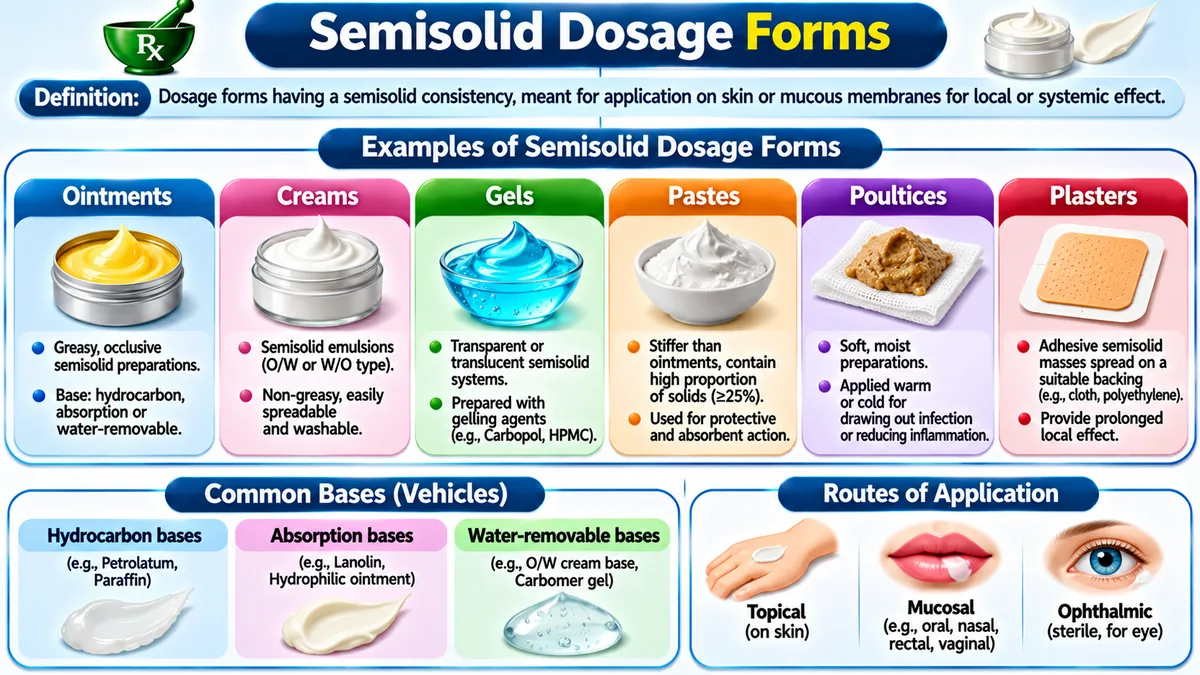
Simple Definition:
A Semisolid Dosage Form is defined as a dermatological preparation of paste-like or intermediate consistency between solid and liquid, intended for application to the skin or accessible mucous membranes for protective, therapeutic, or soothing action.
Classification of Semisolid Dosage Forms:
Greasy, fatty preparations intended for application to the skin or eye with or without inunction (rubbing).
Stiff, firm preparations containing a high proportion (20% to 50%) of finely powdered insoluble solids.
Viscous semisolid emulsions (O/W or W/O) that are easily spreadable and cosmetically appealing.
Transparent or translucent semisolids consisting of liquids trapped within a three-dimensional polymeric network.
- Delivers direct local therapeutic action right at the site of infection or inflammation.
- Bypasses hepatic first-pass metabolism and protects gastric mucosa from irritating drugs.
- Provides prolonged contact time with the skin barrier.
- Easy to apply for patients who have difficulty swallowing tablets or liquids.
- Accurate dosing is difficult because patients apply varying thickness of ointment.
- Greasy ointment bases can stain clothing and bed linen.
- Subject to contamination if patient dips unwashed fingers directly into jars.
- Some bases can cause skin irritation or contact dermatitis in sensitive individuals.
2. The 4 Classes of Ointment Bases and Formulation Excipients
An Ointment Base is defined as the inert vehicle that carries the active medicament and determines the release, penetration, and texture of the final preparation.
| Base Class | Key Properties | Official Pharmacopoeial Examples |
|---|---|---|
| 1. Oleaginous (Hydrocarbon) Bases | Greasy, hydrophobic, highly occlusive; prevents moisture evaporation from skin; not water-washable. | White Soft Paraffin IP (Vaseline), Yellow Soft Paraffin, Hard Paraffin, Liquid Paraffin. |
| 2. Absorption Bases | Greasy, but contains emulsifiers that absorb large volumes of aqueous solutions to form W/O emulsions. | Wool Fat (Anhydrous Lanolin IP), Hydrous Wool Fat (contains 25%–30% water), Wool alcohols base. |
| 3. Water-Removable (Emulsion) Bases | Oil-in-Water (O/W) emulsion bases; non-greasy, cosmetically elegant, easily washed off the skin with plain water. | Hydrophilic Ointment USP, Vanishing cream bases, Emulsifying Ointment IP. |
| 4. Water-Soluble (Greaseless) Bases | Completely lipid-free; formulated from water-soluble synthetic polymers; wash off cleanly like soap without staining. | Polyethylene Glycols (PEGs / Macrogols: blend of liquid PEG 400 and solid PEG 4000). |
Other Excipients Used in Semisolid Formulations:
Inhibit oxidative rancidity of fats and oils (e.g., Butylated hydroxytoluene - BHT, Butylated hydroxyanisole - BHA, α-tocopherol).
Prevent bacterial and mold contamination in water-containing bases (e.g., Methylparaben 0.15%, Propylparaben 0.05%, Benzoic acid).
Retain moisture in cream bases and prevent drying of the formulation (e.g., Glycerin, Propylene glycol, Sorbitol 70%).
Stabilize emulsion bases (e.g., Sodium lauryl sulfate, Cetostearyl alcohol, Polysorbate 80, Sorbitan monostearate).
Bind trace heavy metal ions that catalyze chemical oxidation (e.g., Disodium EDTA, Citric acid).
Facilitate deeper penetration of drug across the stratum corneum (e.g., Dimethyl sulfoxide - DMSO, Propylene glycol).
3. General Methods of Preparation of Ointments, Pastes, Creams and Gels
Method A: The Trituration Method
- • It is also known as: The Cold Method of ointment preparation.
- • It is used for: Incorporating insoluble solid drug powders or liquids into soft ointment bases without applying heat.
- • In this method, we do the following steps:
1. Sifting: Pass drug powder through sieve #85 or #100 to ensure fine particles.
2. Levigation: Place powder on an ointment slab/tile. Add a few drops of levigating liquid (liquid paraffin or melted base) and shear with a flexible stainless steel spatula until a smooth paste is formed.
3. Geometric Dilution: Add the ointment base in small increasing portions, triturating thoroughly after each addition until uniform.
Method B: The Fusion Method (Hot Method)
Used when the ointment base contains high-melting solid waxes (beeswax, hard paraffin, cetostearyl alcohol):
1. Order of Melting: Melt base ingredients on a water bath in descending order of melting points (melt hard paraffin first, then soft paraffin, then wool fat).
2. Avoid Overheating: Heating highest melting components first prevents overheating and burning the low-melting components.
3. Cooling & Stirring: Stir continuously until the mixture congeals into a smooth, lump-free ointment.
A Paste is defined as a semisolid preparation with high solid powder content (20% to 50%).
Preparation: Prepared by trituration method. High powder content makes pastes firm, absorbent of wet oozing skin secretions, and localized. Example: Zinc Oxide Paste IP (Lassar's Paste) containing 24% ZnO, 24% starch, and white soft paraffin.
A Cream is defined as a semisolid emulsion for topical use.
Preparation: Heat oil phase and aqueous phase separately to ~70°C. Add aqueous phase slowly into oil phase with constant stirring until cool.
• Cold Cream (W/O): Beeswax + Borax produce sodium soap emulsifier.
• Vanishing Cream (O/W): Stearic acid + alkali soap; rubs invisible.
A Gel is defined as a transparent semisolid system formed by gelling agents.
Preparation: Disperse gelling polymer (Carbopol 934, Methylcellulose, Sodium CMC) in water. Neutralize acidic Carbopol with triethanolamine or sodium hydroxide to trigger polymer uncoiling into a sparkling, viscous gel (e.g., Diclofenac Sodium Gel).
4. Suppositories and Pessaries: Definitions, Types, Advantages & Disadvantages
Simple Definition:
A Suppository is defined as a solid or firm unit dosage form of various shapes and weights intended for insertion into body cavities (rectum, vagina, urethra) where it melts, softens, or dissolves at physiological body temperature (37°C) to exert local or systemic pharmacological actions.
Types of Suppositories by Anatomical Route:
Tapered torpedo or bullet shape for easy rectal sphincter insertion. Weight: ~2 g for adults, ~1 g for children. Used for constipation (Glycerin suppositories) or systemic fever/pain (Paracetamol).
Globular, oviform, or cone shaped. Weight: 3 g to 5 g. Formulated with glycerinated gelatin base to treat local fungal/bacterial vaginitis (Clotrimazole pessaries).
Slender, pencil-shaped cylindrical rods. Dimensions: Male bougies: 10–15 cm long (2–4 g); Female bougies: 6–7.5 cm long (1–2 g). Inserted into urethra.
Pointed thin rods (nasal bougies) and cylindrical ear cones (aural bougies) weighing ~1 g, formulated for nasal or external ear canal therapy.
- Ideal for patients who are unconscious, vomiting, or unable to swallow oral drugs.
- Partial bypass of hepatic first-pass metabolism (lower hemorrhoidal veins drain directly into systemic circulation).
- Protects acid-labile drugs from gastric acid degradation and protects stomach from irritating drugs (e.g., NSAIDs like Indomethacin).
- Direct local action in the rectum or vagina without whole-body side effects.
- Poor patient acceptance and psychological hesitation towards rectal or vaginal routes.
- Irregular or incomplete drug absorption due to rectal fecal matter or small fluid volume (~3 mL).
- Special storage required: fatty suppositories melt in warm tropical weather (must be refrigerated at 2°C to 8°C).
- Manufacturing on commercial scale requires specialized moulding machinery and strict temperature controls.
5. Suppository Bases, Properties of Ideal Base & Cocoa Butter Polymorphism
Properties of an Ideal Suppository Base:
- Melting Characteristics: Must remain firm and solid at room temperature (below 30°C) but melt or dissolve rapidly at body temperature (36.5°C to 37°C).
- Non-toxic & Non-irritating: Must not cause mucosal irritation or allergic reactions in cavity linings.
- Volume Contraction: Must shrink slightly on cooling so the finished suppository releases smoothly from the mould cavities without sticking.
- Chemical Inertness: Must be compatible with a wide range of drugs and excipients without decomposing.
| Class | Suppository Base Type | Properties & Practical Usage |
|---|---|---|
| A. Fatty Bases | Theobroma Oil (Cocoa Butter IP) | Natural vegetable fat from roasted seeds of Theobroma cacao. Melts cleanly at 30°C–35°C. Exhibits polymorphism. |
| Synthetic Fats (e.g., Witepsol, Massa Estarinum) | Hydrogenated vegetable triglycerides. No polymorphism, solidifies quickly, resistant to oxidation. | |
| B. Water-Soluble Bases | Glycerinated Gelatin Base IP | Formula: 14% Gelatin + 70% Glycerin + 16% Purified Water. Dissolves slowly in body secretions; ideal for vaginal pessaries. |
| Polyethylene Glycols (PEGs / Macrogols) | Blends of PEG 1000, 4000, and 6000. Do not melt; dissolve in mucosal fluid. Clean, stable, high melting point (does not require refrigeration). |
Polymorphism of Cocoa Butter (Theobroma Oil)
Cocoa butter consists of triglycerides that can crystallize into 4 distinct physical forms (polymorphs) depending on the heating temperature and cooling rate:
| Polymorphic Form | Melting Point | Physical Stability | Conditions of Formation |
|---|---|---|---|
| γ (Gamma) Form | 18°C | Very Unstable | Formed by rapid flash chilling of melted cocoa butter on ice. |
| α (Alpha) Form | 22°C to 24°C | Unstable | Formed by cooling cocoa butter that was overheated above 36°C. |
| β′ (Beta-prime) Form | 28°C | Metastable | Formed by slow, undisturbed cooling of melted cocoa butter. |
| β (Beta) Form [Stable] | 34.5°C | Stable Form | Formed by gentle melting below 35°C so existing crystal seeds remain intact. |
6. Displacement Value (DV): Concept, Formula & Solved Numericals
Simple Definition:
Displacement Value (DV) is defined as the number of parts by weight of a medicament that displaces one part by weight of the suppository base.
Why Displacement Value is Required: Suppository moulds are calibrated to hold a fixed volume of base (e.g., 1 g or 2 g of cocoa butter). When heavy drug powder is incorporated, it occupies volume in the mould and displaces a certain quantity of the melted base. If we do not account for displacement value, the suppository cavities will overflow, leading to inaccurate drug dosing.
Formula for Determining Displacement Value:
• w: Total weight of drug in the prepared medicated suppositories.
• G: Weight of blank suppositories made with pure base alone (mould capacity).
• M: Weight of medicated suppositories containing drug + base.
Question: Prepare 6 suppositories, each containing 250 mg of Zinc Oxide. The suppository mould has a capacity of 1 g of cocoa butter. The displacement value (DV) of Zinc Oxide is 5.0. Calculate the quantities of drug and base required (prepare for 8 suppositories to account for practical mould wastage).
Step 1: Calculate total drug required for 8 suppositories (including wastage):
• Drug per suppository = 250 mg = 0.25 g
• Total Zinc Oxide = 8 × 0.25 g = 2.0 g
Step 2: Calculate pure base capacity for 8 suppositories:
• Total theoretical base = 8 × 1.0 g = 8.0 g
Step 3: Calculate base displaced by the drug:
• Base displaced = (Total weight of drug) / DV
• Base displaced = 2.0 g / 5.0 = 0.40 g of cocoa butter
Step 4: Calculate actual quantity of cocoa butter needed:
• Actual base = Total base - Base displaced
• Actual base = 8.0 g - 0.40 g = 7.60 g of cocoa butter
7. General Method of Suppository Preparation (Step-by-Step Moulding)
In the laboratory and compounding pharmacy, suppositories are prepared using metal moulds by the Fusion (Moulding) Method through the following standardized steps:
Melt pure base, pour into clean mould cavities to overflow, chill, trim flat with knife, and weigh suppositories. Divide total weight by cavity count to find true mould capacity G.
Apply a thin film of lubricant to prevent sticking. Rule of Opposite Polarity:
• For Fatty Bases (Cocoa Butter): Use water-soluble lubricant (Alcohol/Soap spirit or Liquid paraffin:soft soap mix).
• For Water-Soluble Bases (Gelatin/PEG): Use oily lubricant (Liquid Paraffin).
Melt base gently on a warm water bath (≤ 35°C for cocoa butter). Rub fine drug powder with a few drops of melted base on a warm tile, then mix back into bulk melted base with steady stirring.
Pour the creamy warm mixture in a continuous steady stream into mould cavities until each cavity overflows. Why overfill? Bases shrink upon cooling; overfilling prevents hollow depression holes at the top.
Allow mould to cool at room temperature, then place in refrigerator for 15 minutes to completely congeal. Remove mould and slice away the excess overfilled cap using a warm, sharp knife flat against the mould surface.
Unscrew the metal mould wing-nut and separate the mould halves. Push suppositories gently out. Wrap individually in aluminum foil or waxed paper and package in partitioned boxes. Store in cool place (refrigerated at 2°C–8°C).