Professional Communication in Healthcare Settings
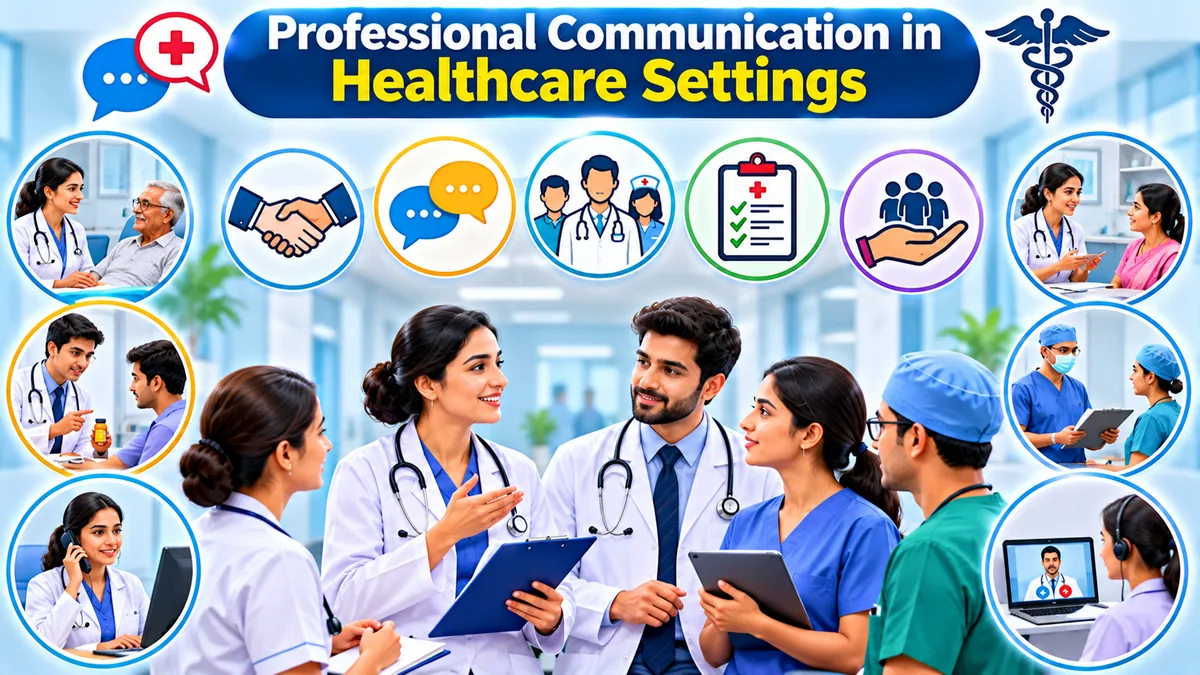
In modern hospitals and clinical pharmacies, pharmacists work alongside doctors, nurses, surgeons, and caregivers. Poor communication between team members is the leading cause of medical errors worldwide. In this unit, we learn structured interprofessional communication using SBAR, how to break tragic news using the SPIKES protocol, legal and ethical confidentiality principles, writing SOAP clinical notes, and utilizing digital telepharmacy tools.
In this topic, you will learn:
1. Communication with Patients, Caregivers, and Interdisciplinary Teams (SBAR)
Clinical Team Handover & Counseling (Defined in Simple Words):
Simple Definition:
Interprofessional Communication is defined as the collaborative sharing of patient information, clinical findings, and therapeutic recommendations between pharmacists, physicians, nurses, and allied healthcare staff to ensure patient safety.
Visual Diagram: The SBAR Framework for Calling Physicians in Emergencies
Identify yourself, the hospital ward, the patient name, and the immediate urgent problem.
Provide brief, relevant clinical history and current medication orders.
State your professional clinical evaluation of what you believe is happening.
Propose a clear, actionable pharmaceutical recommendation to solve the risk.
2. Delivering Difficult News and Handling Emotionally Charged Situations
Delivering a diagnosis of malignant cancer, chronic kidney failure requiring lifelong dialysis, or irreversible drug side effects is one of the hardest challenges in healthcare. Pharmacists and clinicians follow the internationally standardized 6-Step SPIKES Protocol:
Ensure absolute privacy in a quiet room, have tissues available, sit down at eye-level with the patient, and turn off mobile ringers.
Find out what the patient already knows or suspects: "What did the doctor tell you about the biopsy results?"
Ask how much detail the patient wants to hear: "Would you like me to discuss the full pathology report, or focus on treatment?"
Use a gentle warning shot first ("I'm afraid the test results did not come back as well as we hoped"), then explain in non-technical terms without blunt cruelty.
Allow the patient to weep in silence; hand them a tissue; offer compassionate validation: "I can see how heartbreaking this news is."
Outline a clear, hopeful, step-by-step treatment plan so the patient does not leave feeling abandoned: "Here is our immediate step tomorrow..."
De-escalation Technique for Angry or Distressed Patients:
Never say "Calm down!" (this makes people angrier). Instead, keep a soft, steady voice, do not interrupt their venting, validate their frustration ("I completely understand why waiting 2 hours for this medicine made you upset"), and present an immediate practical remedy.
3. Legal and Ethical Issues in Health Communication: Confidentiality & Consent
A. Patient Confidentiality (Medical Privacy)
Confidentiality is defined as the strict ethical duty and legal obligation of healthcare workers never to disclose a patient's medical diagnosis, prescriptions, or records to third parties without express consent.
- Governed by HIPAA internationally and DISHA (Digital Information Security in Healthcare Act) & Pharmacy Council of India Code of Ethics.
- Severe Violation: Discussing a neighbor's HIV or antidepressant prescription with friends in public pharmacy aisles.
B. Informed Consent
Informed Consent is defined as the voluntary agreement given by a mentally competent patient to undergo a specific treatment, procedure, or drug trial after being fully informed of all benefits, risks, and alternatives.
- Requires: Full information disclosed, mental competence, and zero coercion.
- Patients always have the fundamental legal right to refuse treatment.
4. Writing Patient Records, Reports, and Discharge Summaries (SOAP Format)
• The SOAP Note is defined as a universal structured clinical documentation method consisting of Subjective, Objective, Assessment, and Plan.
• It is also known as: Problem-oriented medical record (POMR) progress notes.
• It is used for: Standardizing clinical pharmacy case files, charting drug-related problems, and communicating clinical rationale across medical teams.
• In this method, we: Record patient complaints in Subjective, vitals/lab values in Objective, therapeutic diagnosis in Assessment, and dosage regimen interventions in Plan.
In Simple Words (The Doctor's & Pharmacist's Diary):
Whenever a patient visits a hospital, health professionals keep clear, organized records so the next nurse or pharmacist knows the exact story. They write this using the simple 4-letter formula SOAP:
• S (Subjective): What the patient feels and tells you ("I have a terrible dry cough for 2 days").
• O (Objective): What machines and blood tests measure (BP is 138/86 mmHg, heart rate is 74).
• A (Assessment): What the pharmacist diagnoses ("The dry cough is a common side-effect of the BP pill Ramipril").
• P (Plan): The exact step-by-step fix ("Switch medicine to Telmisartan and follow up next week").
| SOAP Component | What It Contains | Clinical Pharmacist Example |
|---|---|---|
| S — Subjective | Information reported directly by the patient (symptoms, complaints, history). | "Patient complains of dry cough and dizziness for 2 days after starting new BP medicine." |
| O — Objective | Measurable clinical data (vitals, lab tests, ECG, serum creatinine). | BP: 138/86 mmHg, Pulse: 74 bpm, Serum Creatinine: 1.1 mg/dL, Rx: Ramipril 5 mg OD. |
| A — Assessment | The healthcare professional's diagnosis or drug therapy problem evaluation. | ACE-inhibitor-induced dry cough (bradykinin accumulation) and mild orthostatic hypotension. |
| P — Plan | Actionable medical plan: drug switch, lab monitoring, patient counseling. | Switch Ramipril to ARB (Telmisartan 40 mg OD); advise getting up slowly from bed; review in 7 days. |
Pharmacist Role in Hospital Discharge Summaries:
When a patient leaves the hospital, the pharmacist prepares a Medication Reconciliation summary listing all old medicines stopped, newly added drugs, exact morning/night dosages, and scheduled follow-up blood tests, preventing post-discharge hospital readmissions.
5. Use of Technology and Digital Communication Tools in Healthcare Services
Direct digital transmission of prescriptions from physician to pharmacy; eliminates handwriting misinterpretation errors and forged opioid orders.
Software that scans electronic health records (EHR) and instantly alerts pharmacists if a newly prescribed drug clashes fatally with the patient's existing pills.
Cloud-connected glucometers and blood pressure monitors that beam live readings to the pharmacist, enabling instant phone dosage adjustments for rural patients.