Foundations of Health Communication
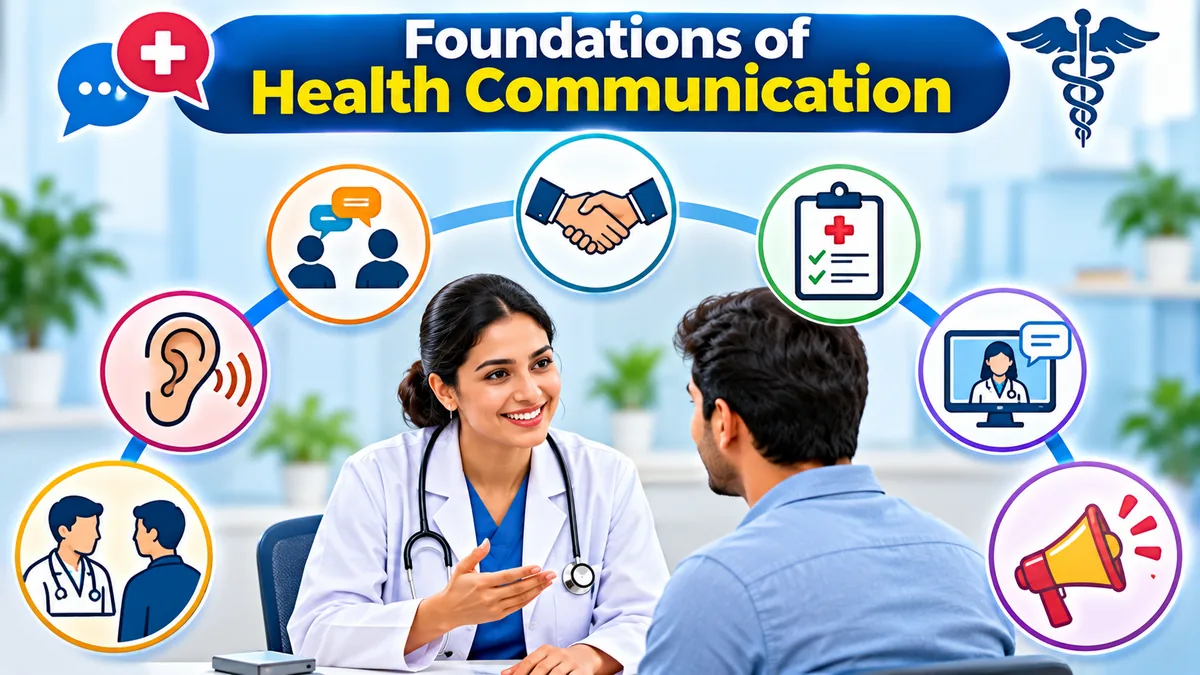
Communication in healthcare can save lives. If a pharmacist cannot explain dosage schedules clearly, or fails to listen to an elderly patient's concerns, fatal drug interactions and non-compliance happen. In this unit, we explore the elements and models of communication, interpersonal vs. telehealth channels, clinical barriers, active listening (the SOLER framework), questioning techniques, and culturally inclusive care.
In this topic, you will learn:
1. Elements and Models of Communication in Healthcare
Health Communication (Defined Simply):
Health Communication is defined as the science and art of using message strategies to inform, motivate, and guide individuals and communities on health-related choices and medications.
Simple Definition:
Health Communication is defined as the two-way transactional process through which healthcare professionals and patients generate, exchange, and interpret health information to influence positive wellness and treatment outcomes.
Visual Diagram: The SMCR Communication Model with Feedback in Clinical Pharmacy
Patient demonstrates inhaler technique back to pharmacist (closing the loop & verifying understanding).
Mehrabian's 7-38-55 Rule of Communication:
When communicating feelings and attitudes, patient trust is built predominantly through non-verbal channels:
2. Types of Health Communication: Interpersonal, Group, Mass & Telehealth
A. Interpersonal Communication
Direct, face-to-face, one-on-one interaction between a pharmacist and a patient at the counseling counter.
B. Group Communication
Communication among small groups (e.g., multidisciplinary hospital rounds, diabetic patient support circles).
C. Mass Communication
Dissemination of public health messages to large, diverse populations via television, radio, posters, and billboards.
D. Telehealth & Telepharmacy
Delivery of pharmaceutical care, prescription verification, and patient counseling using digital video calls and chat apps.
3. Barriers to Effective Communication in Clinical Settings
A barrier is any obstacle that prevents the patient from accurately receiving or understanding the healthcare message:
| Barrier Category | Real Clinical Examples | Practical Solution for Pharmacists |
|---|---|---|
| 1. Physical & Environmental | Noisy pharmacy counter, high glass partitions, crowded waiting halls, lack of privacy. | Create a dedicated, quiet, private counseling cubicle away from ringing phones. |
| 2. Language & Jargon | Using complex medical words like "sublingual", "nephrotoxic", or English with non-English speakers. | Use simple vernacular words: "keep under tongue"; use visual pictograms of sunrise and sunset. |
| 3. Physiological & Sensory | Elderly patients with hearing impairment, cataracts (blurred vision), or tremors. | Face the patient directly, speak clearly at lower pitch, and provide large 18pt font printouts. |
| 4. Psychological & Emotional | Panic, grief, depression, acute pain, or anger over medical delays. | Acknowledge emotions first ("I can see you are in pain") before giving drug instructions. |
4. Active Listening, Questioning Techniques, and Empathy in Patient Care
• The SOLER Framework is defined as an active non-verbal listening protocol designed to convey complete therapeutic attention, empathy, and presence to a patient.
• It is used for: Establishing immediate trust during sensitive patient interviews.
• In this method, we: Sit Squarely, maintain an Open posture, Lean forward, maintain comfortable Eye contact, and remain Relaxed.
The "SOLER" Framework for Non-Verbal Active Listening:
Developed by Gerard Egan, this physical posture signals genuine warmth and total attention to the patient:
Effective Questioning Techniques: Open-Ended vs. Closed-Ended
Questions that cannot be answered with a simple "yes" or "no"; they encourage the patient to explain in detail.
• "What did your doctor tell you this medicine is for?"
• "How have you been taking your blood pressure tablets?"
Questions that require a quick factual answer or single word.
• "Are you allergic to Penicillin?"
• "Did you take your morning dose with breakfast?"
• Sympathy: Feeling sorry for the patient from a detached distance ("I'm sorry you have cancer, that must be terrible."). It often makes the patient feel pitied.
• Empathy: Understanding and feeling the experience with the patient from their perspective ("I can understand how overwhelming this diagnosis feels for your family; let's walk through your treatment plan together step by step."). Empathy creates clinical therapeutic alliance.
5. Culturally Appropriate and Inclusive Healthcare Communication
Simple Definition:
Cultural Competence is defined as the ability of healthcare professionals to deliver effective medical care that respects the diverse cultural beliefs, dietary habits, languages, and religious practices of patients.
During Ramadan or Navratri fasting, adjust diabetic insulin and sulfonylurea timing to prevent dangerous hypoglycemic fainting.
Ensure strict vegetarian patients receive cellulose-based (HPMC) capsules instead of bovine/porcine animal gelatin shells.
In many traditional cultures, female patients prefer discussing reproductive or hormonal medications with female pharmacy staff.