Acid-Base Chemistry, Pharmaceutical Buffers, and Physiological Electrolytes
The human body and pharmaceutical formulations require strict chemical equilibrium. Small deviations in pH or mineral ions can precipitate drugs or cause fatal cardiac arrhythmias. In this unit, we explain acid-base theories, pH and buffer equations, isotonic solution calculations, vital physiological electrolytes, WHO-ORS therapy, and physiological acid-base regulation.
In this Unit:
1. Classical Theories of Acids and Bases
Acid-Base Concepts (Explained in Simple Words):
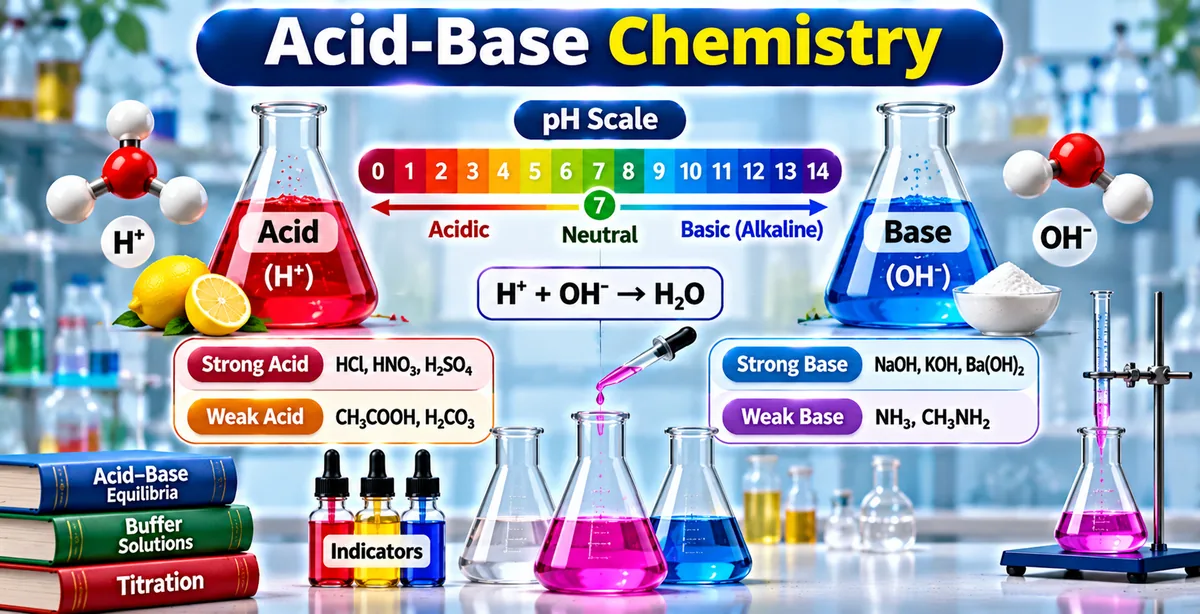
Three major historical theories define how chemical substances behave as acids or bases in pharmaceutical solutions:
Arrhenius Concept
- • It is also known as: Aqueous dissociation theory.
- • It is used for: Explaining standard acid-base behavior in pure water solutions.
- Acid: A substance that dissociates in water to yield hydrogen ions (
H⁺), e.g.,HCl → H⁺ + Cl⁻. - Base: A substance that dissociates in water to yield hydroxyl ions (
OH⁻), e.g.,NaOH → Na⁺ + OH⁻. - Limitation: Applies only to water solutions and fails to explain basicity of substances lacking OH⁻ (e.g., NH3).
Brønsted-Lowry Concept
Based on proton transfer between chemical species:
- Acid: A chemical species that donates a proton (
H⁺donor). - Base: A chemical species that accepts a proton (
H⁺acceptor). - Conjugate Pairs: When an acid loses a proton, it forms its conjugate base; when a base gains a proton, it forms its conjugate acid:
Lewis Concept
Broadest definition based on electron pair transfer:
- Acid: An electron-pair acceptor (electrophile with vacant orbital), e.g.,
BF3,AlCl3,Fe³⁺. - Base: An electron-pair donor (nucleophile with lone pair), e.g.,
:NH3,H2O:. - Forms a coordinate covalent bond (adduct), essential in complexometric titrations.
2. pH Scale and Buffer Solutions
pH is defined as the negative logarithm (base 10) of the hydrogen ion concentration in moles per litre: pH = -log10[H⁺]. In pure neutral water at 25°C, [H⁺] = [OH⁻] = 1.0 × 10⁻⁷ M, giving a neutral pH of 7.0.
Definition of a Buffer Solution:
A buffer solution is defined as a solution that resists drastic changes in its pH upon the addition of small quantities of strong acid, strong base, or upon solvent dilution.
1. Acidic Buffer (e.g., Acetic acid + Sodium acetate)
Composed of a weak acid and its salt with a strong base (CH3COOH + CH3COONa).
2. Basic Buffer (e.g., Ammonium hydroxide + Ammonium chloride)
Composed of a weak base and its salt with a strong acid (NH4OH + NH4Cl).
3. The Henderson-Hasselbalch Buffer Equation
The Henderson-Hasselbalch equation is a mathematical formula that relates the pH of a buffer solution to the dissociation constant (pKa) of the weak acid and the ratio of concentrations between the salt (conjugate base) and the weak acid.
Mathematical Formulation:
Where pKa = -log10(Ka), [Salt] is molar concentration of conjugate base, [Acid] is molar concentration of weak acid.
Where pH = 14 - pOH at 25°C. Allows precise design of ophthalmic and parenteral buffers.
4. Buffer Capacity (Van Slyke Buffer Index)
Buffer capacity (β) is defined as the magnitude of resistance offered by a buffer solution to pH changes. Quantitatively, Donald Van Slyke defined buffer capacity as the number of gram equivalents of strong acid or strong base required to change the pH of 1 litre of buffer solution by exactly 1.0 unit.
Where ΔB = small increment of gram equivalents of strong base/acid added per litre, and ΔpH = resultant change in pH.
[Salt] = [Acid]). At this exact equimolar state, pH = pKa, and βmax = 0.576 × C (where C is total buffer concentration).5. Isotonic Solutions and Osmotic Pressure Adjustment
In parenterals and eye drops, tonicity is critical for patient safety:
Hypotonic Solution
Osmotic pressure lower than body fluids (< 0.9% NaCl).
Isotonic Solution
Osmotic pressure equal to blood plasma (290–300 mOsm/L).
Hypertonic Solution
Osmotic pressure higher than body fluids (> 0.9% NaCl).
Official Reference Isotonic Solutions:
Adjustment of Tonicity: Cryoscopic Method (Freezing Point Depression):
Both blood serum and human lacrimal fluid have a constant freezing point depression of −0.52°C. Any solution freezing at -0.52°C is exactly isotonic.
Where W = weight in grams of adjusting substance (e.g., NaCl) to add per 100 mL; a = freezing point depression of unadjusted drug solution; b = freezing point depression of 1% w/v adjusting substance (0.58 for NaCl).
6. Major Extra- and Intracellular Electrolytes
Electrolytes are inorganic mineral salts that dissociate into electrically charged ions in body fluids. They maintain osmotic pressure, conduct nerve impulses, and regulate cardiac contractions.
| Electrolyte | Primary Location | Normal Serum Level | Key Physiological Functions |
|---|---|---|---|
| Sodium (Na⁺) | Major Extracellular Cation | 135–145 mEq/L | Regulates ECF volume, blood pressure, osmotic equilibrium, and initiates neuronal action potentials. |
| Potassium (K⁺) | Major Intracellular Cation | 3.5–5.0 mEq/L | Governs resting membrane potential, neuromuscular excitability, and cardiac rhythm. Hypokalemia causes fatal arrhythmias. |
| Calcium (Ca²⁺) | Extracellular & Bone matrix | 8.5–10.5 mg/dL | Bone and tooth mineralization, blood clotting cascade (Factor IV), muscle excitation-contraction coupling, neurotransmitter release. |
| Chloride (Cl⁻) | Major Extracellular Anion | 96–106 mEq/L | Maintains electrical neutrality (Chloride shift in RBCs), forms gastric hydrochloric acid (HCl), and balances osmotic pressure. |
| Bicarbonate (HCO3⁻) | Extracellular Buffer Anion | 22–28 mEq/L | Primary chemical alkaline buffer in blood; neutralizes metabolic acids to prevent life-threatening acidosis. |
7. Electrolyte Replacement Therapy Compounds
Sodium Chloride (NaCl)
Molecular Weight: 58.44. Colorless cubic crystals or white crystalline powder.
- Assay: Precipitation titration by Volhard's or modified Volhard's method against standard AgNO3.
- Uses: Used in dehydration, hyponatremia, and to restore blood volume during surgery or burns.
Potassium Chloride (KCl)
Molecular Weight: 74.55. White crystalline powder, freely soluble in water.
- Assay: Precipitation titration with silver nitrate using potassium chromate indicator (Mohr's method).
- Uses: Treats severe hypokalemia caused by prolonged diuretic therapy or vomiting. Must be diluted before IV infusion.
Calcium Gluconate
Molecular Weight: 430.37. White, odorless, slowly soluble powder.
- Assay: Complexometric titration with 0.05 M Disodium EDTA using Mordant Black II (EBT) indicator.
- Uses: Preferred parenteral calcium replenisher for acute hypocalcemic tetany; non-irritating compared to CaCl2.
8. Oral Rehydration Salts (WHO-ORS) Formulation
• Oral Rehydration Salts (ORS) is defined as a dry, balanced powder formulation of glucose, sodium chloride, potassium chloride, and sodium citrate.
• It is also known as: WHO-ORS formula or life-saving rehydration mixture.
• It is used for: Rapid restoration of fluid and electrolyte balance in cholera, pediatric diarrhea, and severe dehydration.
• In this mechanism, we: Rely on the intestinal SGLT-1 co-transporter to force sodium and water absorption into blood across the gut epithelium.
During severe acute watery diarrhoea (e.g., in cholera), massive quantities of water and sodium are lost from the intestinal lumen, leading to fatal hypovolemic shock. Oral Rehydration Salts (ORS) is a life-saving medical breakthrough based on intestinal physiology.
Physiological Basis: SGLT-1 Glucose-Sodium Cotransport
In the brush border of intestinal epithelial cells, there is an active cotransporter protein called SGLT-1 (Sodium-Glucose Cotransporter 1). It binds one sodium ion (Na⁺) and one glucose molecule simultaneously and transports them together into the mucosal cells. Once inside, they create an osmotic gradient that pulls water passively from the gut lumen into the bloodstream. This cotransport system remains 100% operational even during severe cholera toxin infections.
| Ingredient Name | Grams per 1 Litre Water | Ionic Concentration (mmol/L) | Physiological Role |
|---|---|---|---|
| Sodium Chloride (NaCl) | 2.6 g | Na⁺: 75 mmol/L | Replenishes intravascular volume & ECF sodium. |
| Glucose (Anhydrous) | 13.5 g | Glucose: 75 mmol/L | Enables active SGLT-1 sodium & water absorption. |
| Potassium Chloride (KCl) | 1.5 g | K⁺: 20 mmol/L | Prevents dangerous hypokalemic cardiac arrest. |
| Trisodium Citrate Dihydrate | 2.9 g | Citrate: 10 mmol/L | Corrects metabolic acidosis and increases shelf stability. |
| TOTAL POWDER / OSMOLARITY | 20.5 g / Litre | Total = 245 mOsm/L | Low-osmolarity formula reduces stool volume by 30%. |
9. Physiological Acid-Base Balance and Homeostasis
Normal human arterial blood pH is tightly regulated within the extremely narrow physiological window of 7.35 to 7.45. If arterial pH drops below 7.35, the condition is called acidosis; if it rises above 7.45, it is called alkalosis. Blood pH values below 6.8 or above 7.8 are rapidly fatal.
1st Line of Defense: Chemical Blood Buffers (Instant: Fraction of a second)
The primary extracellular buffer is the Carbonic Acid–Bicarbonate System (CO2 + H2O ↔ H2CO3 ↔ H⁺ + HCO3⁻). Maintained at a strict 20:1 ratio of bicarbonate to carbonic acid ([HCO3⁻] / [H2CO3] = 20 / 1) which yields pH 7.4 according to Henderson-Hasselbalch equation. Intracellularly, the phosphate buffer system (H2PO4⁻ / HPO4²⁻) and hemoglobin protect red blood cells.
2nd Line of Defense: Respiratory Regulation (Minutes: Rapid)
The respiratory center in the brainstem detects increases in blood CO2 and H⁺. If acidosis occurs, respiration rate and depth increase (hyperventilation), blowing off excess volatile CO2 gas and returning pH toward 7.4.
3rd Line of Defense: Renal Regulation (Hours to Days: Ultimate Power)
The kidneys are the ultimate physiological regulators because they can permanently eliminate non-volatile fixed acids (sulphuric, phosphoric, lactic acids). Renal tubule cells secrete excess H⁺ into urine (buffered by ammonia to form NH4⁺) and reabsorb 100% of filtered bicarbonate (HCO3⁻) back into circulation.