Gastrointestinal Agents, Topical Antimicrobials, and Radiopharmaceuticals
Inorganic compounds play extensive roles inside the human digestive tract, on external skin wounds, and in high-tech nuclear medicine departments. In this unit, we explain gastrointestinal acidifiers, antacid combinations, osmotic saline cathartics, topical inorganic antimicrobials, and diagnostic/therapeutic radiopharmaceuticals with strict radiation safety rules.
In this Unit:
1. Gastrointestinal Acidifiers
Definition:
An acidifier is defined as a drug or chemical agent that reduces pH or increases acidity in the gastric cavity (gastric acidifier) or systemic fluids/urine (urinary acidifier).
Dilute Hydrochloric Acid (10% w/w HCl)
• It is also known as: Spirit of Salt or Acidum hydrochloricum dilutum.
• It is used for: Treating achlorhydria (lack of gastric HCl) to restore normal pepsin digestion.
- Indication: Used to treat Achlorhydria (absence of HCl secretion in the gastric juice) and hypochlorhydria, which causes severe indigestion and impairs iron/calcium absorption.
- Administration Counseling: Extremely corrosive to teeth! Must always be diluted in water and ingested through a plastic drinking straw to prevent direct contact with dental enamel, followed by thorough mouth rinsing.
Sodium Acid Phosphate (NaH2PO4 • 2H2O)
- Indication: Acts primarily as a urinary acidifier.
- Mechanism: Lowers the pH of urine to 5.0–5.5. This prevents the precipitation of calcium phosphate kidney stones and potentiates methenamine antibacterial action against urinary tract infections.
2. Antacids: Definition and Ideal Properties
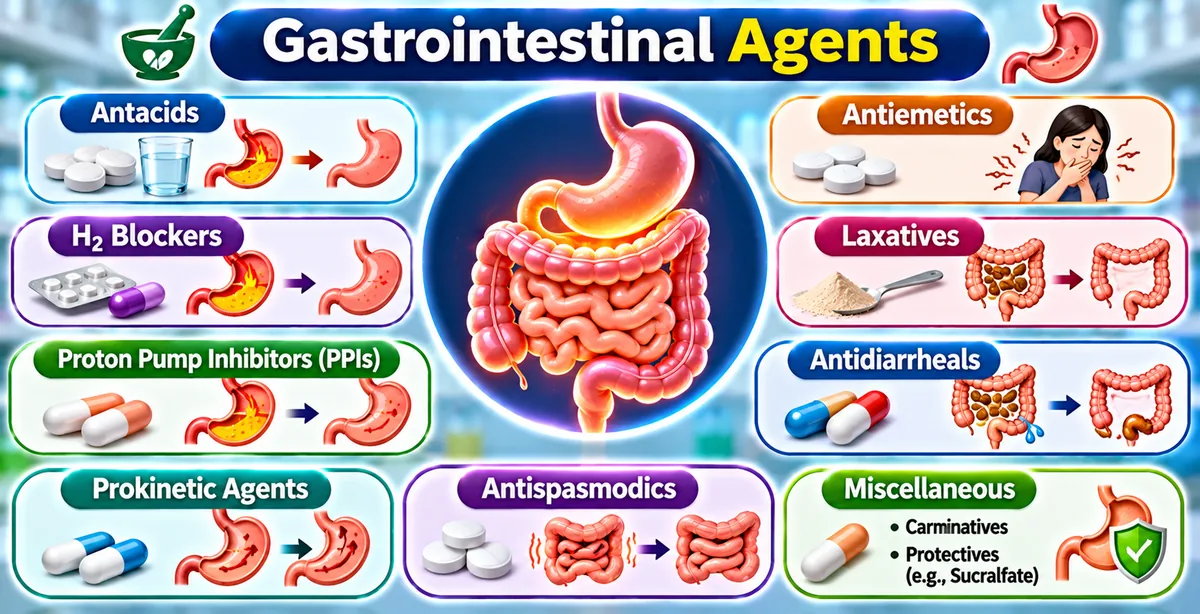
An antacid is defined as a basic pharmaceutical substance that neutralizes excess hydrochloric acid in gastric juice, raising gastric pH to relieve pain from hyperacidity, peptic ulcers, and reflux esophagitis.
CO2) gas, which causes gastric distention, belching, and risk of ulcer perforation.Systemic Antacids (e.g., Sodium Bicarbonate - NaHCO3)
- Highly water-soluble and rapidly absorbed from the gut.
- Releases excessive CO2 gas:
NaHCO3 + HCl → NaCl + H2O + CO2 ↑. - Causes dangerous systemic metabolic alkalosis and severe compensatory acid rebound. Unsuitable for long-term ulcer therapy.
Non-Systemic Antacids (e.g., Aluminium Hydroxide, Magaldrate)
- Sparingly soluble basic salts that act strictly locally in the gastric cavity.
- Forms insoluble phosphates or carbonates that are eliminated harmlessly in feces.
- Does not disturb systemic blood acid-base equilibrium. Considered the golden clinical standard.
3. Formulation Rationale of Antacid Combinations
No single antacid chemical fulfills all ideal criteria. Therefore, modern pharmaceutical suspensions combine aluminum compounds and magnesium compounds together:
Why Aluminium Hydroxide + Magnesium Hydroxide Are Combined:
Aluminium Hydroxide [Al(OH)3]:
- Onset & Duration: Slow onset of action, but very long sustained duration.
- Adverse Effect: Strong astringent property causes severe constipation by relaxing intestinal smooth muscle and binding phosphate.
Magnesium Hydroxide [Mg(OH)2]:
- Onset & Duration: Very fast, immediate onset of action, but short duration.
- Adverse Effect: Acts as an osmotic saline cathartic, causing watery diarrhoea.
4. Saline Cathartics & Laxatives (Promoting Bowel Movement)
A cathartic (or laxative) is defined as an agent that accelerates the passage of fecal matter through the intestinal tract, facilitating defecation.
Mechanism of Osmotic Saline Cathartics:
Saline cathartics contain inorganic cations or anions (such as Mg²⁺, SO4²⁻, Tartrate) that are poorly and slowly absorbed from the mucosal wall of the gastrointestinal tract. They remain inside the intestinal lumen and exert strong osmotic pressure, drawing substantial volumes of water from circulation into the gut lumen. The enlarged fluid volume mechanically stretches the intestinal walls, stimulating reflex propulsive peristalsis.
Magnesium Sulphate (MgSO4 • 7H2O - Epsom Salt)
• It is also known as: Epsom Salt.
• It is used for: Rapid osmotic bowel evacuation, acute constipation, and managing eclamptic convulsions.
Colorless needle crystals with a bitter, saline taste. Both Mg²⁺ and SO4²⁻ ions are poorly absorbed, giving twice the osmotic strength. Rapid evacuation occurs within 2 to 4 hours.
Sodium Potassium Tartrate (Rochelle Salt)
• It is also known as: Rochelle Salt or Seignette's Salt.
• It is used for: Osmotic saline cathartic action (in Seidlitz powder) and preparing Fehling's reagent.
The double tartrate of potassium and sodium (KNaC4H4O6 • 4H2O). A classic osmotic laxative and key ingredient in effervescent Seidlitz powders.
5. Inorganic Topical Antimicrobials and Their 3 Mechanisms
Topical antimicrobials are chemical agents applied locally to skin, mucous membranes, or wounds to kill or inhibit microbial growth. They destroy bacteria through 3 distinct chemical mechanisms:
Oxidation
Strong oxidizing agents oxidize the reactive sulfhydryl (-SH) groups of essential bacterial enzymes into inactive disulfide (-S-S-) bonds, halting bacterial cellular respiration.
Halogenation
Halogen atoms substitute for hydrogen atoms in the peptide bonds and nitrogen groups of bacterial structural proteins, irreversibly destroying protein conformation and function.
Protein Precipitation
Metal cations react with bacterial surface proteins to form insoluble metal-protein complexes (chelates). This curdles bacterial membranes and exhibits astringent protective wound-drying actions.
6. Official Inorganic Antimicrobial Compounds
Hydrogen Peroxide Solution (H2O2 - 6% w/v or 20 Vol)
• It is also known as: Oxygenated water or Dihydrogen dioxide.
• It is used for: Effervescent wound cleaning, mechanical tissue debridement, and mouth antiseptic wash.
- Principle: Decomposes rapidly on contact with wound catalase enzyme, liberating nascent oxygen:
2H2O2 → 2H2O + O2 ↑. - Clinical Action: Mechanical effervescence bubbles out dirt, pus, and necrotic debris from deep anaerobic wounds (effective against Clostridium tetani).
Potassium Permanganate (KMnO4 - Condy's Crystals)
• It is also known as: Condy's Crystals or Permanganate of potash.
• It is used for: Antiseptic wound cleansing, dermatological soaks for weeping eczema, and emergency chemical gastric lavage in alkaloid poisoning.
- Dark purple prismatic crystals. Used as dilute 1:1,000 to 1:10,000 solutions.
- Uses: Powerful disinfectant, astringent wet dressing for weeping eczema, bladder irrigation, and stomach wash antidote in alkaloid poisoning.
Boric Acid (H3BO3)
- Very weak, un-ionized monobasic acid. Extremely non-irritating to delicate mucosal tissues.
- Uses: 2% to 4% sterile solutions widely used as soothing ophthalmic eye lotions, ear drops, and antiseptic dusting powders.
Official Iodine Preparations
- Tincture of Iodine: 2% Iodine + 2.5% Sodium Iodide in 50% alcohol.
- Lugol's Solution (Aqueous Iodine Solution): 5% Iodine + 10% Potassium Iodide in water.
- Povidone-Iodine: Complex of iodine with polyvinylpyrrolidone polymer; non-staining, non-irritating water-soluble antiseptic.
7. Radiopharmaceuticals: Basics of Radioactivity and Units
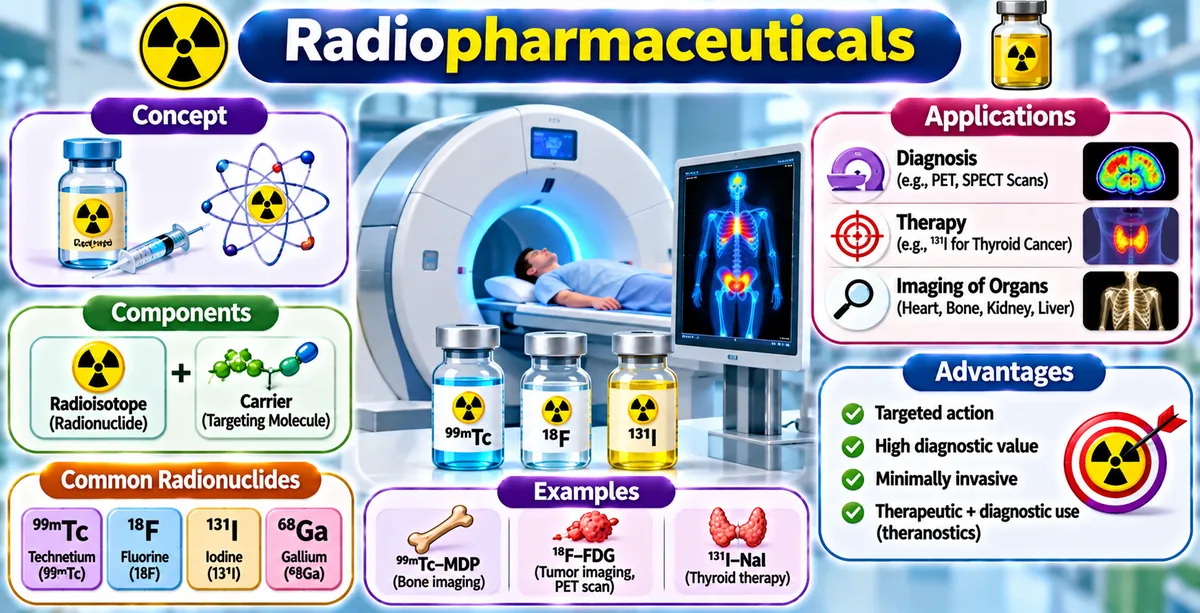
A radiopharmaceutical is defined as a radioactive medicinal compound containing one or more radionuclides, designed and formulated safely for diagnostic imaging or internal radiotherapy in human patients.
| Radiation Type | Physical Nature | Penetrating Power | Shielding Required |
|---|---|---|---|
| Alpha (α) Particles | Helium nucleus (2 protons + 2 neutrons). Heavy mass, +2 charge. | Extremely low (penetrates only 0.05 mm tissue). Highly destructive if ingested. | Stopped by a single sheet of paper or human skin epidermis. |
| Beta (β) Particles | High-speed electrons (β⁻) or positrons (β⁺). Light mass, ±1 charge. | Moderate (penetrates several millimetres into human tissue). Used in internal radiotherapy. | Stopped by 5 mm thick perspex plastic or thin aluminium sheet. |
| Gamma (γ) Rays | High-energy electromagnetic photons. Zero mass, zero electrical charge. | Extremely high (passes through human body easily). Ideal for diagnostic gamma cameras. | Requires thick dense lead bricks or heavy concrete walls. |
Becquerel (Bq) – SI Unit
Defined as exactly 1 radioactive disintegration (transformation) per second.
1 Bq = 1 dpsCurie (Ci) – Traditional Unit
Originally based on the disintegration rate of 1 gram of Radium-226.
1 Curie (Ci) = 3.7 × 10¹⁰ Becquerels (Bq)8. Important Clinical Radioisotopes
Sodium Iodide I-131 (¹³¹I)
t½ = 8.02 Days• It is also known as: Radioiodine 131.
• It is used for: Thyroid scintigraphy imaging and therapeutic ablation of hyperthyroidism and thyroid cancer.
Emits both β particles and γ rays. Thyroid follicular cells actively trap iodide.
Technetium-99m (⁹⁹ᵐTc)
t½ = 6.0 Hours• It is also known as: Technetium isomer 99m.
• It is used for: Over 80% of all diagnostic nuclear gamma-scintigraphy procedures (cardiac perfusion, bone scanning, and brain imaging).
The ultimate workhorse of nuclear medicine (>80% of all diagnostic scans worldwide). Pure gamma emitter (140 keV).
Cobalt-60 (⁶⁰Co)
t½ = 5.27 YearsEmits high-energy penetrating gamma rays (1.17 and 1.33 MeV).
Phosphorus-32 (³²P)
t½ = 14.3 DaysPure beta emitter (1.71 MeV).
9. Radiation Safety, Safe Handling & Storage Guidelines
Radioactive isotopes present insidious biological hazards including DNA double-strand breaks, radiation burns, and leukemia. In India, all radiopharmaceuticals are strictly regulated by the Atomic Energy Regulatory Board (AERB).
Minimize TIME
Total absorbed dose is directly proportional to exposure time. Work swiftly using dry practice runs.
Maximize DISTANCE
Radiation intensity decreases with the square of distance (Inverse Square Law: I ∝ 1/d²). Always use long-handled tongs or robotic arms.
Use SHIELDING
Store and dispense isotopes behind thick lead-lined glass screens and lead-lined transport containers ("lead pigs").
Safe Storage and Waste Disposal Protocol:
• Personnel Monitoring: Every radiation handler must wear a Thermo-Luminescent Dosimeter (TLD) badge pinned at chest level to monitor cumulative monthly exposure.
• Storage: Radiopharmaceuticals must be stored in locked, fire-proof, lead-shielded chambers designated with international radiation trefoil warning symbols.
• Decay in Storage: Short-lived isotopes (t½ < 60 days) are collected in dedicated lead containers and kept inside radiation bunkers for at least 10 half-lives until radiation decays to background level before standard biohazard incineration.